
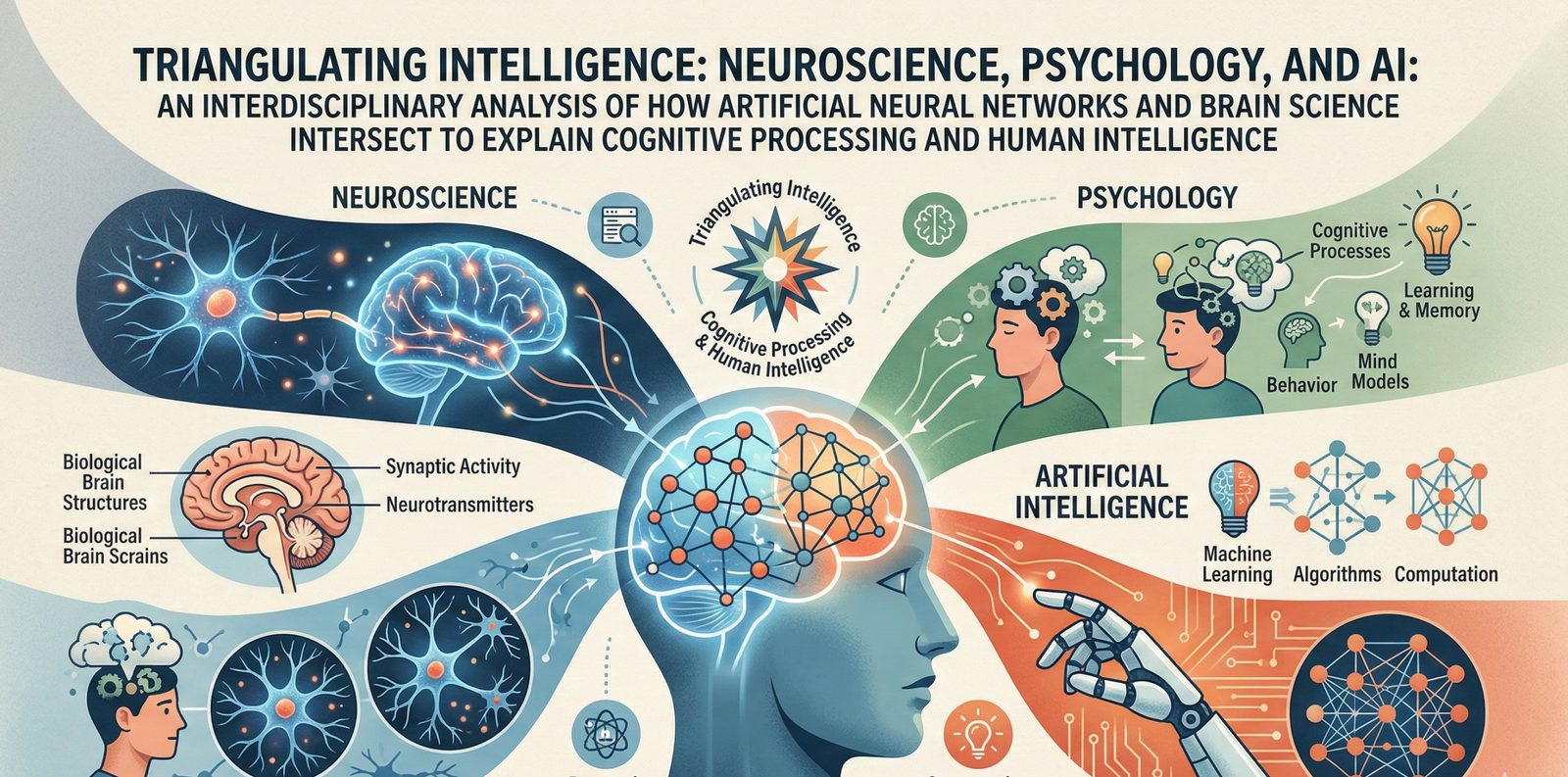

For centuries, the quest to understand human intelligence was confined to the realms of philosophy and theoretical psychology. Today, we are in the midst of a cognitive revolution. To truly decipher the mechanisms of the mind, researchers are no longer relying on a single discipline. Instead, they are triangulating intelligence by merging three powerful fields: Neuroscience, Psychology, and Artificial Intelligence (AI).
This interdisciplinary approach—examining how the “software” of the mind (psychology) runs on the “hardware” of the brain (neuroscience), and how we can simulate both using artificial neural networks (AI)—offers our most promising path to explaining cognitive processing and human intelligence.
The Three Pillars of Intelligence
To understand how these fields intersect, we must first look at what each discipline brings to the table regarding the study of intelligence.
1. Psychology: The Architecture of Behavior and Mind
Psychology provides the functional blueprint of intelligence. It observes what the mind does. Cognitive psychology maps out processes like memory encoding, attention span, problem-solving, and language acquisition. Psychological frameworks, such as the distinction between fluid intelligence (raw problem-solving ability) and crystallized intelligence (accumulated knowledge), give us the behavioral benchmarks that neuroscience and AI strive to explain and replicate.
2. Neuroscience: The Biological Hardware
If psychology is the software, neuroscience is the biological hardware. Neuroscience seeks to understand where and how cognitive processing occurs on a physical level. By mapping the brain’s 86 billion neurons and their trillions of synaptic connections, neuroscientists can observe the biological mechanisms of learning. Concepts like neuroplasticity (the brain’s ability to rewire itself based on experience) provide the physical evidence for psychological theories of learning and adaptation.
3. Artificial Intelligence: The Computational Simulator
Artificial Intelligence, specifically through Artificial Neural Networks (ANNs), acts as a testing ground for theories of mind.
Shutterstock
Explore
AI researchers build computational models inspired by the brain to see if they can produce human-like cognitive behaviors. When an AI system successfully mimics a cognitive process—such as recognizing a face or translating a language—it offers researchers a mathematical framework to understand how the human brain might be accomplishing the same task.
The Intersection: How ANNs and Brain Science Explain Cognition
The true magic happens where these three fields intersect. Modern artificial neural networks are deeply indebted to biological brain science, and in return, these AI models are helping psychologists and neuroscientists understand the human mind better than ever before.
From Biological Neurons to Artificial Nodes
The foundational architecture of modern AI is the neural network, which was directly inspired by the biological brain. In the brain, dendrites receive signals, the soma processes them, and the axon fires an output to the next neuron.
In an artificial neural network, this is mathematically simulated. “Nodes” (artificial neurons) receive data, apply numerical “weights” and “biases” to that data (simulating synaptic strength), and pass the information through an “activation function” (simulating a neuron firing). By layering these nodes, AI can process highly complex information, known as Deep Learning.
Shared Mechanisms: Reinforcement Learning and Dopamine
One of the most striking intersections of these fields is found in Reinforcement Learning (RL). Originally a psychological concept introduced by behaviorists like B.F. Skinner, RL describes how behavior is shaped by rewards and punishments.
Neuroscientists later discovered the biological mechanism for this: the dopamine reward prediction error pathway in the brain. When we experience an unexpected reward, dopamine spikes, strengthening the neural pathways that led to that action.
AI researchers mathematically encoded this exact psychological and biological process to create RL algorithms. This intersection allowed AI systems like DeepMind’s AlphaGo to learn complex games by essentially simulating the brain’s dopamine-driven trial-and-error process.
Visual Processing: Convolutional Neural Networks and the Visual Cortex
How do humans recognize a cat? Psychologists study the perception, while neuroscientists study the visual cortex. In the 1950s, neuroscientists discovered that neurons in the visual cortex are organized hierarchically: some detect simple edges, while deeper neurons process complex shapes.
AI researchers used this exact biological hierarchy to build Convolutional Neural Networks (CNNs). By mimicking the human visual cortex, CNNs revolutionized computer vision. Today, psychologists use CNNs as computational models to test theories about human visual perception, creating a perfect feedback loop between the three disciplines.
The “Black Box” Problem and the Future of Cognitive Science
Despite the massive strides made by triangulating intelligence, significant challenges remain. Deep learning models often suffer from the “black box” problem—we know the input and the output, but the internal decision-making process is a mathematical mystery. Ironically, this mirrors the exact problem psychologists face when studying the human brain.
Furthermore, while ANNs are excellent at specific tasks (narrow AI), they lack the general intelligence, common sense, and emotional processing of humans. The next frontier in this interdisciplinary journey involves:
- Predictive Coding: Testing psychological theories that the brain is not a passive receiver of information, but a “prediction machine” constantly guessing what will happen next, using AI to model this active inference.
- Understanding Consciousness: Using AI to locate the neural correlates of consciousness—the elusive point where physical brain matter gives rise to subjective psychological experience.
Conclusion
Triangulating intelligence through Neuroscience, Psychology, and Artificial Intelligence has fundamentally shifted our understanding of the mind. Psychology provides the phenomena to be explained, neuroscience provides the physical constraints, and AI provides the computational models to test our theories. As these fields continue to converge, we move closer not only to creating more sophisticated artificial minds but to unlocking the deepest mysteries of human cognition itself.