
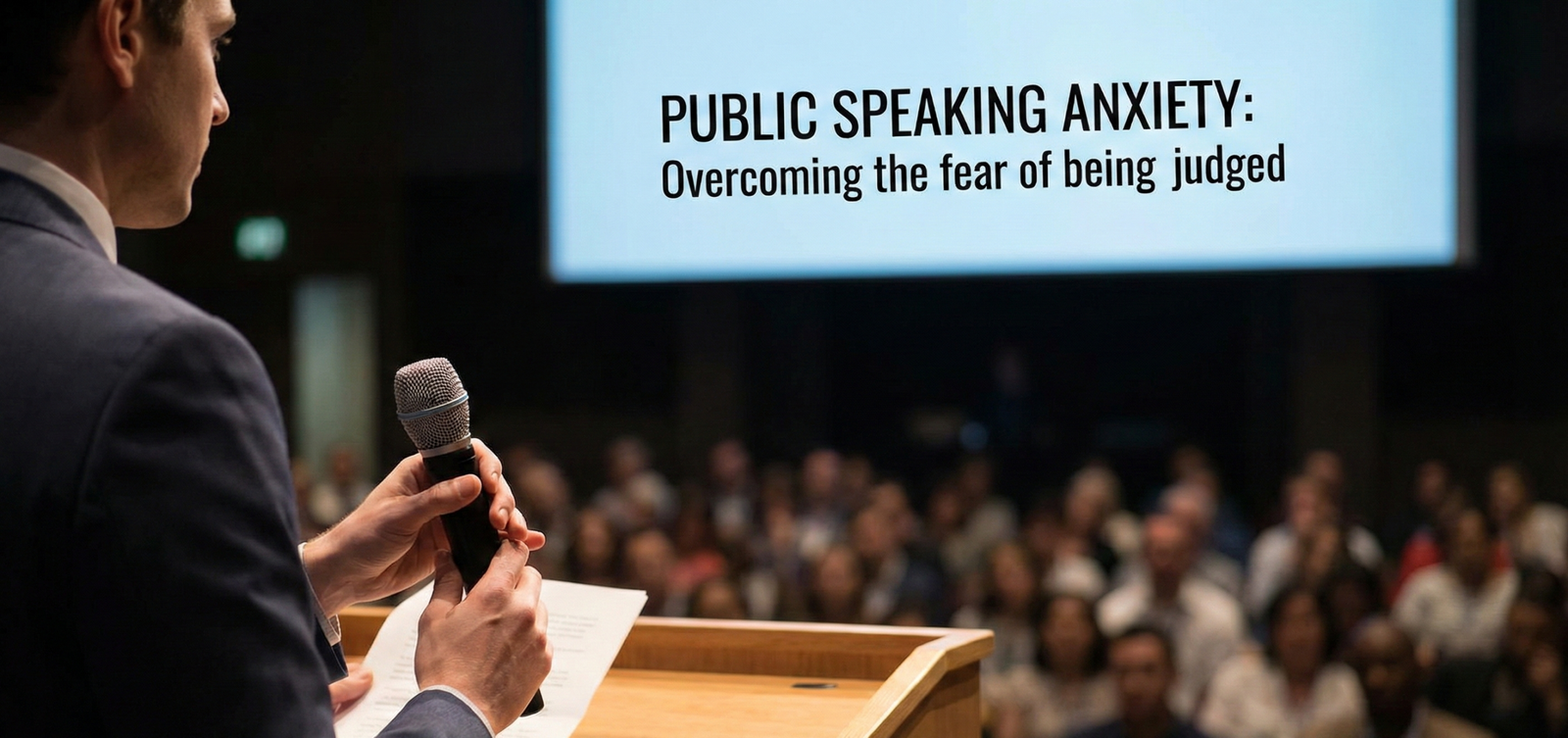

For many, standing before an audience is akin to standing on a precipice. The heart races, palms sweat, and the mind goes blank. This is Public Speaking Anxiety, often referred to in clinical psychology as Glossophobia. It is one of the most common forms of social anxiety, affecting a vast demographic ranging from students to seasoned executives.
At Formal Psychology, we believe that understanding the why behind our fears is the first step to mastering them. This article delves into the psychological roots of this anxiety, the fear of judgment that fuels it, and practical, psychological strategies to reclaim your voice.
Understanding Glossophobia: More Than Just Nerves
While “stage fright” is a common colloquialism, true public speaking anxiety goes deeper than momentary jitters. It triggers the body’s primal Fight or Flight response. When you step onto a stage or in front of a meeting room, your amygdala (the brain’s fear center) perceives the staring eyes of the audience not as a neutral group of people, but as a potential threat.
This biological reaction releases adrenaline and cortisol, leading to physical symptoms such as:
- Rapid heartbeat (tachycardia)
- Trembling or shaking
- Dry mouth
- Gastrointestinal distress
- Mental confusion or “brain fog”
The Psychology of Judgment: Why Do We Care So Much?
The core of public speaking anxiety is rarely about the act of speaking itself; it is almost exclusively about the fear of negative evaluation.
1. The Spotlight Effect
In social psychology, the Spotlight Effect is the phenomenon where people tend to believe they are being noticed more than they actually are. A speaker might feel that every minor stumble, pause, or tremor is being magnified and scrutinized by the audience, whereas the audience likely barely notices these nuances.
2. Fear of Ostracization
Evolutionary psychology suggests that our fear of public rejection is rooted in survival. In early human history, being judged negatively by the tribe could lead to ostracization and death. Today, while a bad presentation won’t kill us, our primitive brain reacts with the same intensity, equating social embarrassment with mortal danger.
3. Perfectionism and Cognitive Distortions
Anxious speakers often fall victim to cognitive distortions—irrational thought patterns that reinforce anxiety. Common distortions include:
- Catastrophizing: “If I mess up this one line, the entire speech is ruined and I’ll be fired.”
- All-or-Nothing Thinking: “I must be perfect, or I am a total failure.”
- Mind Reading: “I can tell by that person’s expression that they think I’m boring.”
Breaking the Cycle: Psychological Strategies for Overcoming Anxiety
Overcoming the fear of judgment requires a combination of cognitive restructuring (changing how you think) and behavioral techniques (changing what you do).
1. Cognitive Reframing
Instead of viewing the speech as a performance where you are being judged, reframe it as a contribution.
- Shift the Focus: Move your attention away from yourself (How do I look? Do I sound smart?) and toward the audience (How can I help them? What value am I giving?).
- Challenge the Critic: When your inner critic says, “You’re going to fail,” counter it with evidence. Remind yourself of past successes and your preparation.
2. Controlled Exposure (Desensitization)
Avoidance feeds anxiety. The more you avoid speaking, the scarier it becomes. Start small:
- Speak up in small team meetings.
- Ask a question at a seminar.
- Practice in front of a trusted friend or a mirror. Gradual exposure helps your brain relearn that the “threat” is not actually dangerous.
3. Physiological Regulation
You cannot think your way out of a panic attack; you must calm the body first.
- Diaphragmatic Breathing: Deep, slow breaths stimulate the Vagus nerve, activating the parasympathetic nervous system and counteracting the fight-or-flight response.
- Power Posing: Research suggests that adopting expansive, confident postures (standing tall, chest open) for two minutes before speaking can lower cortisol and increase testosterone, boosting feelings of confidence.
4. Preparation and Structure
Anxiety thrives on uncertainty. Thorough preparation reduces the cognitive load during the speech.
- Know Your Material: Don’t just memorize words; understand the concepts.
- Visualize Success: Athletes use visualization to improve performance; speakers can too. Vividly imagine yourself speaking calmly and the audience responding positively.
When to Seek Professional Help
If public speaking anxiety is severe enough to hinder your career, education, or daily life, it may be classified as a specific social anxiety disorder. In such cases, therapies like Cognitive Behavioral Therapy (CBT) are highly effective. CBT helps individuals identify and challenge the underlying beliefs that drive their fear.
Conclusion
The fear of being judged is a deeply human experience, but it does not have to be a silencer. By understanding the psychological mechanisms at play—the spotlight effect, evolutionary fear, and physiological arousal—you can begin to dismantle the anxiety. Remember, the goal of public speaking is not perfection; it is connection. Your audience is rarely looking for a flaw; they are looking for an idea.
Frequently Asked Questions (FAQ)
Q: Is public speaking anxiety a mental illness? A: It can be. While mild nervousness is normal, severe anxiety that disrupts life may be diagnosed as a type of Social Anxiety Disorder (SAD).
Q: Can beta-blockers help with public speaking anxiety? A: Some doctors prescribe beta-blockers to manage physical symptoms (like shaking or rapid heart rate), but they do not address the psychological root of the fear. Always consult a medical professional.
Q: How long does it take to overcome glossophobia? A: There is no set timeline. With consistent practice and cognitive restructuring, significant improvements can be seen in a matter of weeks or months.