
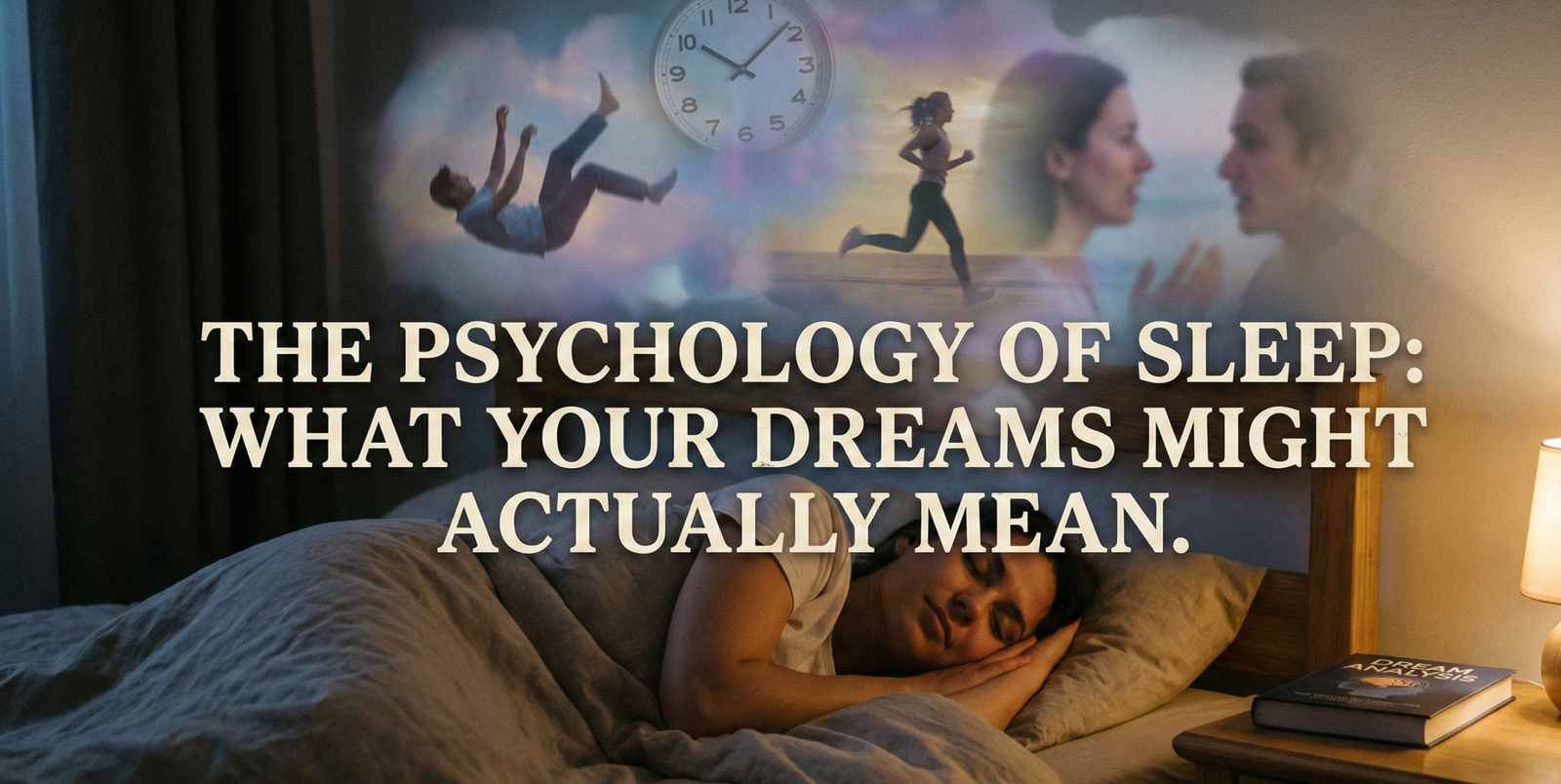

Sleep is often viewed as a passive state—a time when the body shuts down to recharge. However, from a psychological and neurological perspective, sleep is incredibly active. While your body rests, your brain is engaged in a complex process of emotional regulation, memory consolidation, and, perhaps most mysteriously, dreaming.
At Formal Psychology, we believe in bridging the gap between biological function and psychological meaning. In this article, we explore the architecture of sleep and decode the theories behind why we dream.
The Architecture of Sleep: Where Dreams Happen
To understand dreams, one must first understand the stage on which they are performed. Sleep is not a uniform block of time but a cycle of distinct stages, primarily divided into NREM (Non-Rapid Eye Movement) and REM (Rapid Eye Movement).
- NREM Stage 1 & 2: Light sleep where brain waves slow down.
- NREM Stage 3: Deep, restorative sleep essential for physical recovery.
- REM Sleep: The “dream stage.” Here, brain activity resembles that of an awake state, but the body is temporarily paralyzed (atonia).
Most vivid, narrative-driven dreams occur during REM sleep. This is the state where the logic centers of the brain (the prefrontal cortex) are dampened, while the emotional centers (the amygdala) become highly active. This biological shift explains why dreams are often hyper-emotional and bizarrely illogical.
Why Do We Dream? Major Psychological Theories
For centuries, psychologists and neuroscientists have debated the purpose of dreaming. Is it a window into the unconscious, or merely brain static?
1. The Psychoanalytic Perspective: Freud and Wish Fulfillment
Sigmund Freud, the father of psychoanalysis, famously called dreams the “royal road to the unconscious.” In his seminal work, The Interpretation of Dreams (1899), Freud argued that dreams are disguised fulfillments of repressed wishes.
- Manifest Content: The actual imagery of the dream (e.g., losing a tooth).
- Latent Content: The hidden psychological meaning (e.g., anxiety about castration or loss of power).
2. The Jungian Perspective: Archetypes and Balance
Carl Jung, Freud’s contemporary, viewed dreams differently. He believed dreams were not just about repression but about compensation. If you are overworked and stressed in waking life, your dreams might compensate with imagery of peace or chaos to alert you to the imbalance. Jung also introduced the Collective Unconscious, suggesting that certain dream symbols (archetypes like The Shadow or The Hero) are universal across all humans.
3. Activation-Synthesis Theory: The Biological View
Proposed by Hobson and McCarley in 1977, this neurobiological theory suggests that dreams are the brain’s attempt to make sense of random neural activity. During REM sleep, the brain stem fires random signals. The cortex, which is the “storytelling” part of the brain, tries to stitch these random signals into a coherent narrative—resulting in a dream.
4. Threat Simulation Theory (TST)
Evolutionary psychologists propose that dreaming serves a survival function. TST suggests that dreams allow us to practice handling threatening situations (being chased, fighting, falling) in a safe environment, sharpening our survival instincts for waking life.
Common Dream Motifs and Psychological Interpretations
While “dream dictionaries” are often pseudoscientific, recurring themes often reflect common psychological stressors.
- Falling: Often linked to feelings of insecurity, loss of control, or fear of failure in one’s career or relationships.
- Being Chased: Usually indicates avoidance. You may be running away from a confronting emotion, a difficult conversation, or a deadline.
- Teeth Falling Out: Psychologically, this is often associated with anxiety about appearance, communication (regretting something you said), or a feeling of powerlessness.
- Flying: Generally represents a desire for freedom or a sense of rising above a difficult situation (lucid dreamers often trigger this intentionally).
The Function of Dreaming: Emotional First Aid
Modern research leans heavily into the idea of dreams as emotional regulation. Matthew Walker, author of Why We Sleep, describes REM sleep as “overnight therapy.”
During REM sleep, we process difficult emotional memories in a brain state completely devoid of noradrenaline (a stress molecule). This allows us to strip the painful emotional charge from our memories, so we can recall a traumatic event the next day without being crippled by the immediate visceral reaction.
Conclusion
Whether you view dreams as messages from the unconscious or merely the brain’s nightly data processing, their psychological impact is undeniable. They reflect our anxieties, consolidate our memories, and regulate our moods. By paying attention to your dreams, you gain a unique vantage point into your own psyche—one that is often obscured during the waking hours.