
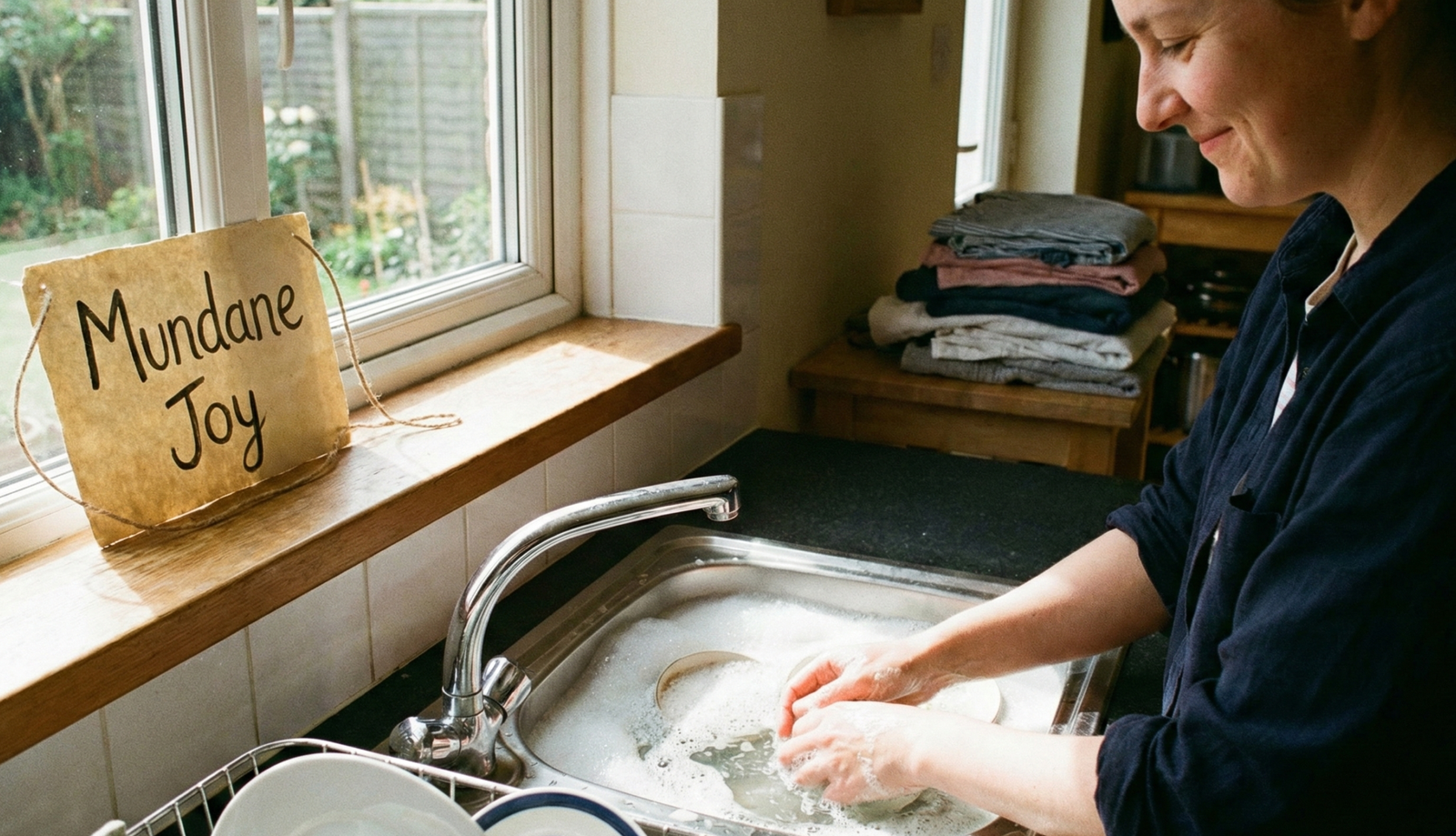

In a world that constantly chases the extraordinary—the next big promotion, the dream vacation, or the viral moment—we often overlook the vast majority of our lives: the middle ground. This is the realm of the “mundane.” It consists of folding laundry, chopping vegetables, entering data, or walking the same route to work every day.
Psychologically, these tasks are often dismissed as “boring” or “mind-numbing.” However, emerging research and ancient mindfulness traditions suggest that these repetitive activities hold a secret capacity for happiness. This is the Mundane Joy: the psychological state of finding peace, flow, and satisfaction in the repetitive.
The Psychology of Repetition: Why the Brain Loves Routine
To understand why we can find joy in boredom, we must first understand Cognitive Ease.
The human brain is an energy-expensive organ. It constantly seeks to conserve energy by creating patterns and shortcuts. When we engage in complex, novel tasks (like learning a new language or solving a crisis at work), our brains are in a state of high cognitive load.
In contrast, repetitive tasks allow the brain to shift gears.
- Predictability reduces cortisol: When a task is predictable, the brain doesn’t need to scan for threats constantly. This lowers stress hormones.
- The Default Mode Network (DMN): While doing “mindless” tasks, our brain’s DMN activates. This is the network responsible for daydreaming, self-reflection, and consolidation of memories. It is why you often get your best ideas while taking a shower or driving.
The Flow State in the Laundry Room
Mihaly Csikszentmihalyi, the father of positive psychology, coined the term “Flow”—a state of complete immersion in an activity. While we usually associate flow with artists or athletes, it is easily accessible through repetitive tasks.
Repetitive tasks provide the clear goals and immediate feedback required for flow:
- Clear Goal: The sink is full of dirty dishes; the goal is to empty it.
- Immediate Feedback: You wash a plate, and it is instantly clean.
This micro-accomplishment loop releases dopamine. Unlike the delayed gratification of long-term career goals, the “mundane” offers a series of small, immediate “wins” that the brain finds deeply satisfying.
Mindfulness: “Wash the Dishes to Wash the Dishes”
The joy in repetitive tasks is often a practice of mindfulness.
Thich Nhat Hanh, the renowned Buddhist monk, famously taught the concept of “washing the dishes to wash the dishes.” If you wash the dishes only to have clean plates, the activity is a chore—a barrier between you and “relaxing.” You are rushing toward the future, inducing mild anxiety.
However, if you focus entirely on the warmth of the water, the smell of the soap, and the circular motion of the sponge, the activity becomes a meditation. This anchors you in the present moment, which is the primary antidote to anxiety (fear of the future) and depression (regret of the past).
The Therapeutic Effect of “Cleaning”
There is a reason why “cleaning videos” have millions of views online and why many people “stress clean.”
- Restoring Order: Psychological distress often stems from a feeling of losing control. Cleaning or organizing offers a tangible way to restore order to one’s environment, which psychologically mirrors restoring order to one’s mind.
- Visual Clarity: A cluttered environment competes for neural resources. Clearing visual clutter frees up mental bandwidth.
How to Cultivate Mundane Joy
If you find yourself dreading the daily grind, try applying these psychological shifts:
1. Reframe the Narrative
Stop calling it a “chore.” Label it a “reset.” Instead of saying, “I have to fold the laundry,” tell yourself, “I am taking 10 minutes to reset my environment.”
2. Engage the Senses
Turn off the podcast or TV. Focus strictly on the sensory input of the task.
- Texture: Feel the fabric while folding.
- Sound: Listen to the rhythm of chopping vegetables.
- Sight: Watch the dust disappear from a surface.
3. Embrace “Single-Tasking”
We live in an era of chronic multitasking. Use repetitive tasks as a sanctuary for single-tasking. Commit to doing only that one thing for the duration. This gives your prefrontal cortex a much-needed break from switching contexts.
Conclusion
The “mundane” is not the enemy of excitement; it is the foundation of stability. By shifting our perspective, we can transform repetitive tasks from burdens into opportunities for mental rest and mindfulness.
Happiness is not always found on the mountaintops of achievement. Often, it is found in the valleys of our daily routine, hiding in the simple, rhythmic joy of a job well done.