
Vision feels effortless. You open your eyes, and the world simply exists in front of you—vivid, dynamic, and instantly recognizable. However, this seamless experience is an illusion created by one of the most computationally demanding processes in the human body.
Understanding the neuro-psychology of the human visual system requires tracing the journey of light from the physical world into the dark, silent theater of the skull, where the occipital lobe constructs our visual reality.
The Journey Begins: From Retina to the Cortex
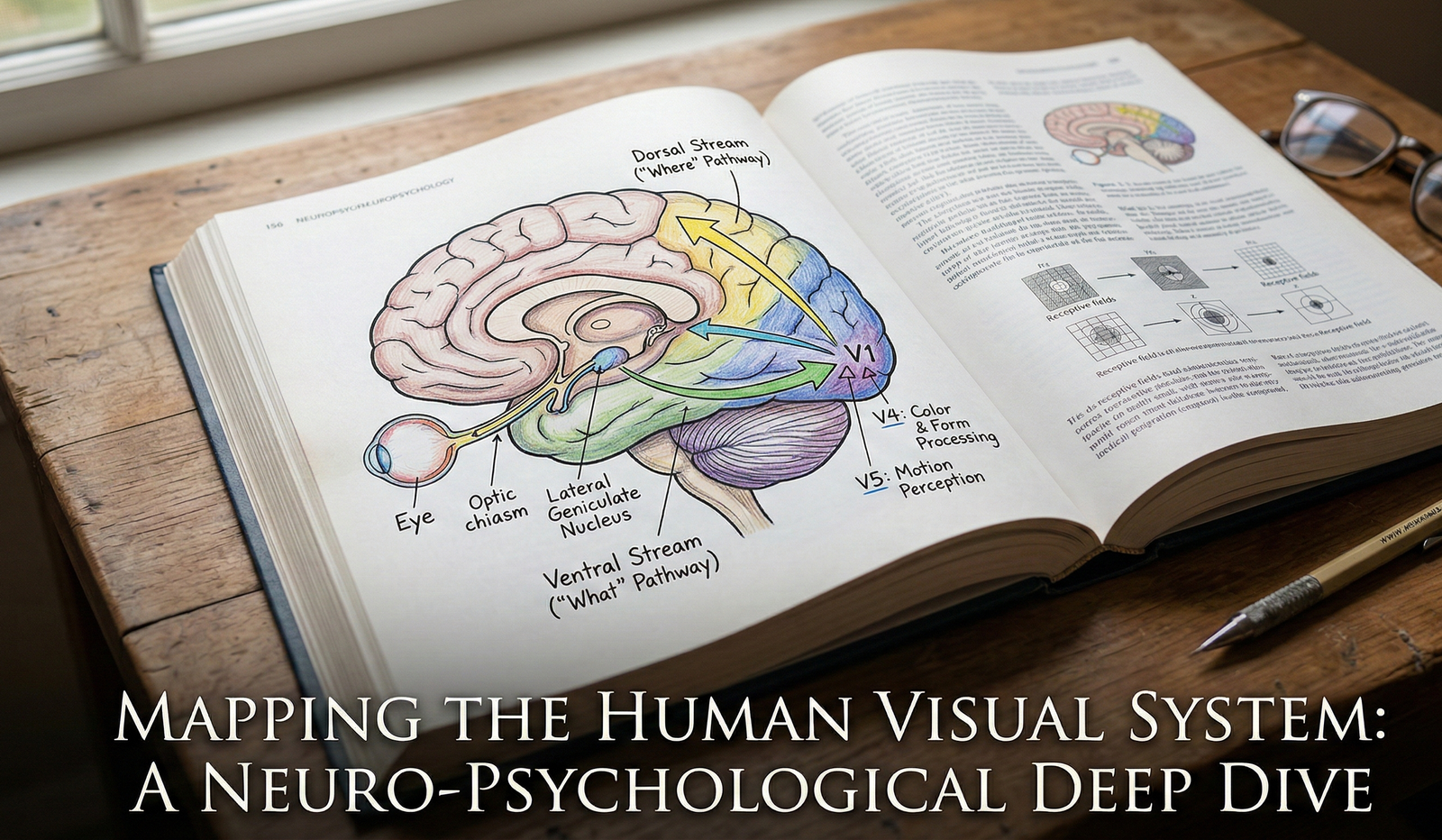
Visual perception does not begin in the brain; it begins with light hitting the retina at the back of the eye. Photoreceptors (rods and cones) transduce electromagnetic energy into neural signals. These signals travel via the optic nerve, crossing at the optic chiasm, and make their first major pit stop at the Lateral Geniculate Nucleus (LGN) in the thalamus.
The LGN acts as a strategic relay station, filtering information before sending it to the back of the brain—the occipital lobe.
The Occipital Lobe: The Brain’s Graphics Processor
Located at the posterior of the brain, the occipital lobe is dedicated almost entirely to visual processing. The gateway to this processing is the Primary Visual Cortex (V1).
When signals reach V1, the brain does not see a “picture” of the world. Instead, V1 meticulously deconstructs the visual field into its most basic elements. Neurons here are highly specialized; some fire only in response to vertical lines, others to specific angles, spatial frequencies, or contrasts.
From V1, the information is routed through progressively complex processing areas (V2, V3, V4, and V5), each adding a layer of interpretation:
- V4 is heavily involved in processing color and complex geometric forms.
- V5 (also known as MT) is the brain’s motion-tracking center, calculating the speed and direction of moving objects.
The Two-Stream Hypothesis: “What” and “Where”
Once the occipital lobe has extracted the basic features of a scene, the data must be interpreted. Where is this object, and what exactly is it? To answer these questions, visual information splits into two distinct neurological highways, known as the Two-Stream Hypothesis.
1. The Ventral Stream: The “What” Pathway
This pathway travels downward from the occipital lobe into the temporal lobe. It is responsible for object recognition, identification, and assigning meaning to what you see.
- Real-World Application: When you are at a crowded networking event and suddenly spot the face of a former colleague across the room, your ventral stream is doing the heavy lifting. It allows you to instantly distinguish your car keys from a similarly shaped USB drive on a cluttered desk.
2. The Dorsal Stream: The “Where/How” Pathway
This pathway travels upward into the parietal lobe. It is responsible for spatial awareness, detecting motion, and guiding your physical interactions with the environment.
- Real-World Application: When you are navigating your car into a tight parallel parking space, your dorsal stream calculates the spatial relationship between your vehicle and the curb. If a colleague knocks a hot cup of coffee off a conference table and you instinctively reach out to catch it mid-air, your dorsal stream is guiding that rapid, precise motor action.
Categorizing Complex Environments: Top-Down vs. Bottom-Up
The occipital lobe does not work in isolation. Making sense of complex environments requires a constant dialogue between bottom-up processing (sensory data flowing up from the eyes) and top-down processing (expectations, memories, and context flowing down from the prefrontal cortex and hippocampus).
Imagine scanning a dense, multi-tabbed spreadsheet for a specific data error. Your bottom-up processing detects the grid lines, numbers, and cell colors. However, your top-down processing—your knowledge of accounting and what the error should look like—guides your eye movements to the exact row that needs fixing.
Similarly, reading the subtle micro-expressions of a client during a high-stakes negotiation requires the visual cortex to rapidly process facial muscle movements (bottom-up), while your social cognition networks instantly categorize those movements as “hesitation” or “approval” (top-down).
When the Map Tears: Visual Agnosias
The segmented nature of the visual system becomes starkly apparent when specific areas are damaged, resulting in conditions known as agnosias. Because perception is modular, a person can lose one specific aspect of vision while retaining the rest:
- Prosopagnosia (Face Blindness): Damage to the fusiform face area (in the ventral stream) leaves a person completely unable to recognize faces, even those of their immediate family, despite having otherwise perfect vision.
- Akinetopsia (Motion Blindness): Damage to area V5 results in the inability to perceive motion. The world appears as a series of disjointed, static strobe-light images. Pouring a cup of coffee becomes incredibly dangerous, as the liquid appears frozen until it suddenly overflows.
Conclusion
The human visual system is a masterpiece of biological engineering. The occipital lobe, working in concert with the intricate pathways of the brain, seamlessly transforms chaotic wavelengths of light into a cohesive, actionable, and meaningful reality. By understanding these mechanisms, we gain profound insight into how we navigate, interpret, and ultimately survive in a highly complex visual world.