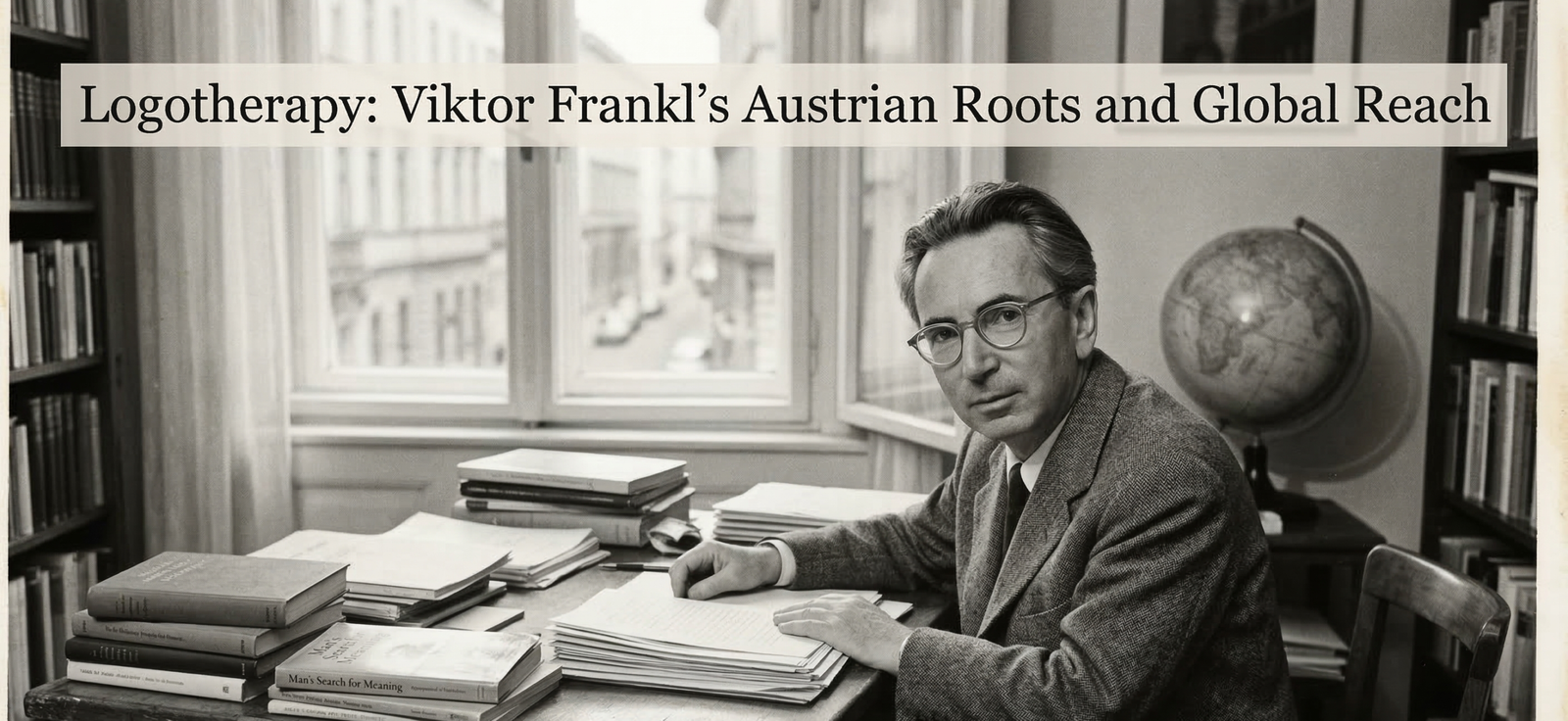

The pursuit of meaning is arguably the most fundamental of all human endeavors. In the landscape of modern psychology, no framework addresses this pursuit more directly or profoundly than Logotherapy. Developed by the Austrian neurologist and psychiatrist Viktor E. Frankl, Logotherapy is often recognized as the “Third Viennese School of Psychotherapy,” following Sigmund Freud’s psychoanalysis and Alfred Adler’s individual psychology.
Unlike its predecessors, which focused on the will to pleasure or the will to power, Logotherapy posits that humanity’s primary motivational force is the will to meaning. This article explores the origins of Logotherapy in the intellectual crucible of early 20th-century Austria, its core tenets, and its enduring global impact.
The Austrian Roots: Vienna and the Birth of Logotherapy
To understand Logotherapy, one must first understand the psychological climate of Vienna in the 1920s and 1930s. Vienna was the undisputed capital of the psychological world. Freud had already established psychoanalysis, emphasizing unconscious drives and past traumas. Adler had introduced his theories on the inferiority complex and the drive for superiority.
Viktor Frankl, born in Vienna in 1905, was deeply immersed in this environment. He corresponded with Freud as a teenager and later studied closely under Adler. However, Frankl eventually broke away from both. He felt that Freud’s determinism reduced human beings to mere reactors to biological instincts, while Adler’s focus on power did not capture the spiritual depth of the human experience.
Frankl believed that humans were not merely driven by drives or shaped by their environment, but were fundamentally defined by their capacity to pull themselves toward a self-chosen future. By the late 1930s, Frankl had coined the term “Logotherapy”—derived from the Greek word logos, which translates to “meaning.”
The Ultimate Test: The Holocaust
The philosophical foundation of Logotherapy was forged in academia, but it was ruthlessly tested in the darkest chapters of human history. During World War II, Frankl, who was Jewish, was imprisoned in several Nazi concentration camps, including Auschwitz and Dachau.
Stripped of his identity, his family, and his life’s work, Frankl found himself in an environment designed to extinguish the human spirit. Yet, it was here that he observed the empirical validation of his theory. He noted that the prisoners who survived were not necessarily the most physically robust, but rather those who held onto a sense of purpose—whether it was the hope of reuniting with a loved one, or an unfinished task waiting for them outside the barbed wire.
“He who has a why to live for can bear almost any how.” — Friedrich Nietzsche (frequently quoted by Frankl)
Core Principles of Logotherapy
Logotherapy rests on three fundamental philosophical pillars that distinguish it from other psychotherapeutic modalities:
- Freedom of Will: Logotherapy asserts that humans are not entirely dictated by biological, psychological, or sociological conditions. While we cannot always control what happens to us, we retain the absolute freedom to choose our response to those circumstances.
- Will to Meaning: This is the primary motivation in humans. We are not primarily seeking pleasure or avoiding pain; rather, we are looking for a reason to be happy or to endure pain. When this will is frustrated, it leads to an “existential vacuum”—a state of inner emptiness and boredom that Frankl identified as a root cause of modern depression, addiction, and aggression.
- Meaning in Life: Logotherapy maintains that life has meaning under all circumstances, even the most miserable. Meaning is not something we invent; it is something we discover.
Three Ways to Discover Meaning
Frankl outlined three primary avenues through which individuals can find meaning in their lives:
- By Creating a Work or Doing a Deed: This is the meaning found in achievement, creation, and contribution to the world.
- By Experiencing Something or Encountering Someone: This encompasses the meaning found in truth, beauty, nature, culture, and, most importantly, through loving another human being.
- By the Attitude We Take Toward Unavoidable Suffering: When faced with a fate that cannot be changed (such as an incurable disease or the loss of a loved one), meaning can be found in the courage and dignity with which one bears that suffering.
The Global Reach of Frankl’s Legacy
Following his liberation in 1945, Frankl returned to Vienna and poured his experiences and theories into the book Man’s Search for Meaning. Originally titled A Psychologist Experiences the Concentration Camp, the book became an international phenomenon. It has sold millions of copies worldwide and has been translated into over two dozen languages, cementing Logotherapy’s place on the global stage.
Modern Applications in Psychology
Today, Logotherapy is not viewed merely as a historical relic, but as an active, evolving branch of existential psychotherapy. Its global reach is evident in various fields:
- Clinical Psychology and Counseling: Therapists utilize logotherapeutic techniques like paradoxical intention (inviting the patient to intend the very thing they fear) and dereflection (redirecting attention away from the self toward others) to treat anxiety, OCD, and depression.
- Trauma Recovery: Logotherapy is highly effective in helping survivors of trauma reframe their experiences, moving from a narrative of victimization to one of resilience and purpose.
- Palliative Care: In medical settings, Frankl’s principles provide crucial frameworks for helping terminal patients face death with peace and dignity.
Conclusion
From the intellectual debates of pre-war Vienna to the brutal realities of the Holocaust, and finally to the global stage, Viktor Frankl’s Logotherapy has proven to be a resilient and transformative psychological framework. In a modern era frequently plagued by the “existential vacuum,” Logotherapy offers a profound reminder: while we cannot always avoid suffering, we always possess the power to find meaning within it.