
Meta Description: Discover the psychology behind the IKEA Effect—a cognitive bias where labor leads to love. We explore the science of effort justification, the famous origami experiments, and how this phenomenon shapes consumer behavior and mental well-being.
Keywords: IKEA Effect, Cognitive Bias, Effort Justification, Consumer Psychology, Dan Ariely, Michael Norton, Psychology of Value, Do-It-Yourself Psychology
Introduction: The Labor of Love
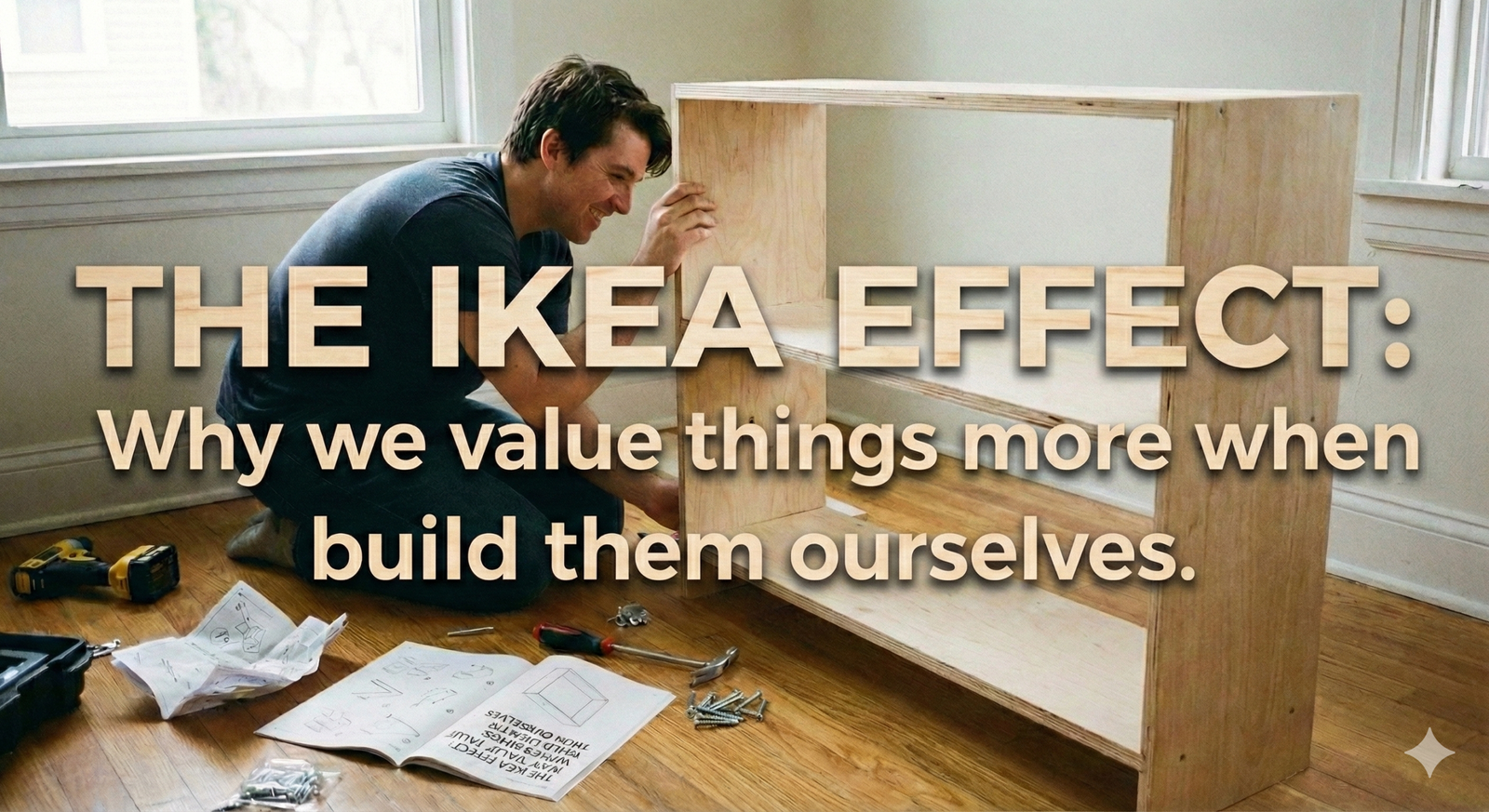
Have you ever struggled to assemble a wobbly bookshelf, deciphering confusing diagrams and wrestling with an Allen key, only to step back and feel an immense sense of pride? To an objective observer, that bookshelf might look crooked. But to you, it is a masterpiece.
This phenomenon is known in psychology as The IKEA Effect. It is a cognitive bias in which consumers place a disproportionately high value on products they partially created. The labor we invest leads to love, transforming ordinary objects into “our” creations.+1
For readers of Formal Psychology, understanding this effect offers a fascinating glimpse into the intersection of cognitive dissonance, self-efficacy, and perceived value.
The Science: Defining the IKEA Effect
The term was coined and popularized in a 2011 paper titled “The IKEA Effect: When Labor Leads to Love” by researchers Michael I. Norton (Harvard Business School), Daniel Mochon (Tulane University), and Dan Ariely (Duke University).
Their research posited a simple yet profound hypothesis: labor alone can be sufficient to induce greater liking for the fruits of one’s labor. This effect holds true even when the final product is objectively inferior to a pre-assembled alternative.
The Core Experiments
To prove this, Norton, Mochon, and Ariely conducted several now-famous experiments:
- The Origami Experiment: Participants were asked to fold origami cranes and frogs. They were then asked to bid on their own creations.+1
- The Result: Builders bid significantly more for their own (often crinkled and imperfect) origami than non-builders were willing to pay. In fact, builders valued their amateurish creations nearly as highly as expert-made origami.
- The key finding: The builders were blind to the flaws in their work. They assumed others would see the same value they did.
- The LEGO Experiment: Participants built simple LEGO structures. Some were allowed to keep their creations intact (meaningful labor), while others were forced to disassemble them immediately after building (Sisyphic labor).
- The Result: The IKEA Effect dissipated when the labor was rendered meaningless. This suggests that the effect isn’t just about the effort—it is about the completion of a task and the validation of competence.
Psychological Mechanisms: Why Does This Happen?
Why does our brain trick us into overvaluing our own labor? Psychology points to three primary drivers:
1. Effort Justification & Cognitive Dissonance
This is a classic concept in social psychology. When we expend significant energy on a task, we need to justify that effort to ourselves. If the result were worthless, our effort would have been wasted, creating a state of uncomfortable cognitive dissonance. To resolve this, our brain unconsciously inflates the value of the outcome. “I worked hard on this; therefore, it must be valuable.”
2. Need for Competence (Self-Efficacy)
Humans have an innate drive to feel competent and capable. Successfully manipulating our environment—whether building a table or baking a cake—fulfills a deep psychological need to demonstrate mastery. The physical product stands as proof of that competence.
3. The Endowment Effect
The IKEA Effect is closely related to the endowment effect, where people ascribe more value to things merely because they own them. The act of building strengthens this sense of ownership. It is not just a table; it is my table.
Beyond Furniture: The IKEA Effect in Daily Life
While named after the Swedish furniture giant, this psychological principle applies to almost every domain of human activity.
- Cooking (The “Egg Theory”): In the 1950s, instant cake mixes were failing because they were too easy. All the consumer had to do was add water. Psychologists Ernest Dichter famously advised the company to remove the powdered egg from the mix, requiring the customer to add their own fresh egg. Sales skyrocketed. Why? The added labor made baking the cake feel like a legitimate accomplishment rather than a cheat.
- Digital Products: Users often value social media profiles or customized playlists more when they have spent hours curating them. The effort of “building” a digital identity creates a strong psychological attachment (and retention) for the platform.
- Animal Training & Parenting: The tremendous effort required to raise a child or train a pet often correlates with the depth of the bond. The “labor” involved creates a deeply entrenched value that an outsider cannot fully appreciate.
The “Dark Side” of the IKEA Effect
While the IKEA Effect can boost satisfaction, it can also lead to poor decision-making, particularly in business and creative fields.
- Sunk Cost Fallacy: Entrepreneurs and managers may fall in love with a failing project simply because they have worked hard on it. They may ignore objective market feedback because their labor has biased their valuation of the idea.
- “Not Invented Here” Syndrome: Companies may reject superior external solutions or technologies in favor of inferior internal ones, simply because their own team built them.
Conclusion
The IKEA Effect teaches us that value is subjective and malleable. As we publish articles here at Formal Psychology, we understand that the human mind does not just observe value—it creates it through action.
Whether you are a marketer looking to increase engagement, a manager trying to motivate a team, or just someone trying to understand why you can’t throw away that crooked bookshelf, the lesson is clear: We love what we build.