
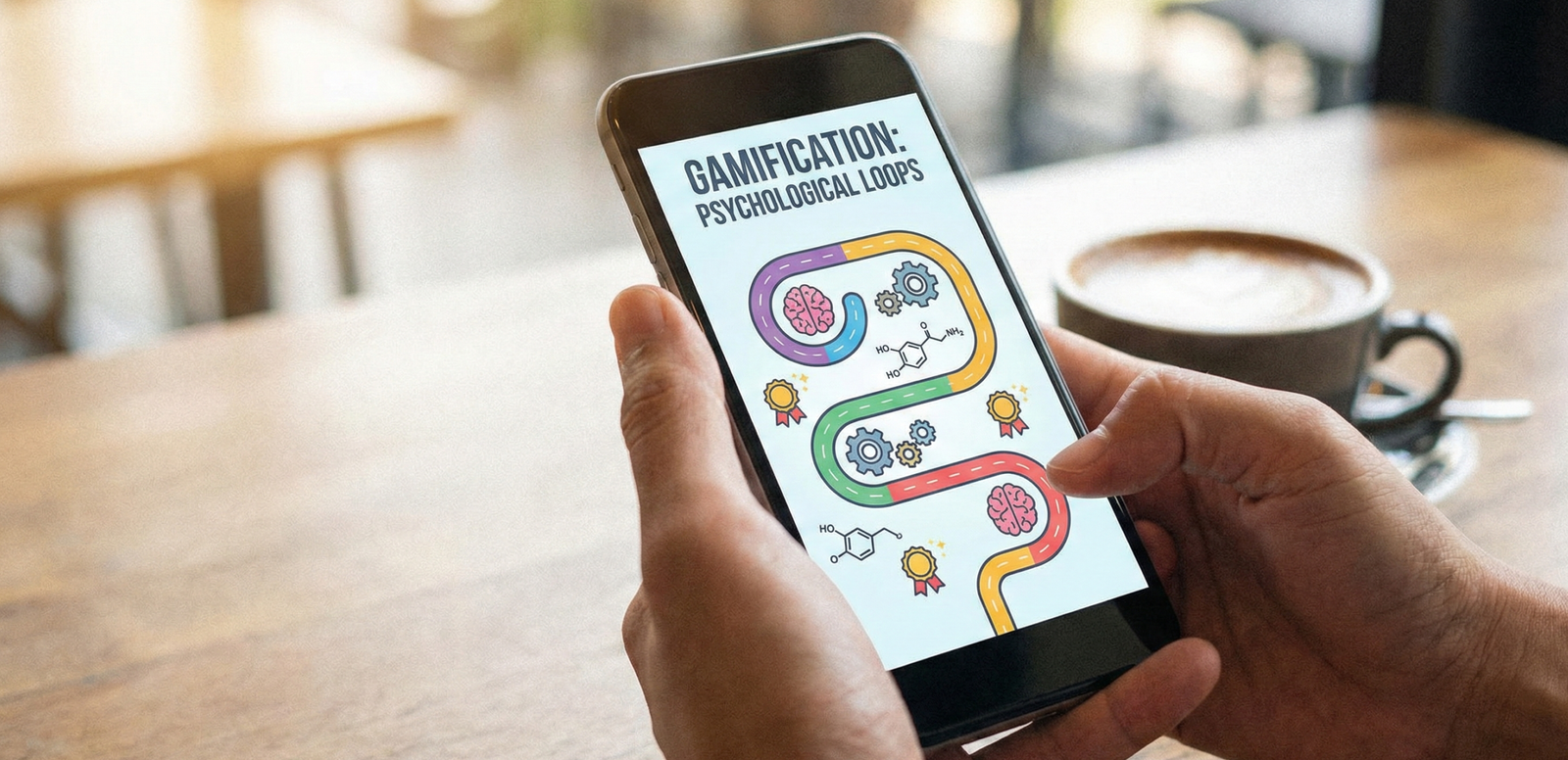

In the digital age, our attention is the world’s most valuable currency. Whether you are learning a new language on Duolingo, tracking your steps on Fitbit, or scrolling through TikTok, you are engaging with systems rooted in gamification psychology. This field studies how game-design elements can be applied in non-game contexts to maximize engagement.
While it often feels like harmless fun, gamification psychology leverages fundamental cognitive biases and neurochemical loops to foster habit formation, often blurring the line between engagement and compulsion.
The Neurochemistry of “The Loop”
At the heart of gamification psychology lies the neurotransmitter dopamine. Contrary to popular belief, dopamine is not just a “pleasure molecule”; it is a craving molecule. It governs desire and motivation.
Apps utilize a mechanism known as the Dopamine Prediction Error. When you receive a reward that is unexpected or better than predicted, your brain releases a surge of dopamine, strengthening the neural pathways associated with that action.
The Skinner Box Effect
This concept draws directly from B.F. Skinner’s research on Operant Conditioning. Skinner discovered that the most effective way to reinforce behavior was not through consistent rewards, but through Variable Ratio Schedules of Reinforcement.
- Fixed Ratio: You get a reward every time you press a button. (Result: Predictable behavior, easy to lose interest).
- Variable Ratio: You get a reward sometimes when you press a button, but you never know when. (Result: Obsessive behavior).
Social media feeds are the ultimate variable reward system. You pull to refresh (the action), but you don’t know what you will get (the variable reward)—it might be a boring ad, or it might be a viral video. The uncertainty keeps the dopamine loop firing.
The Hook Model: A Blueprint for Habit Formation
Nir Eyal, in his seminal work Hooked, outlines the four-step cyclical process that apps use to create unprompted user engagement.
1. The Trigger
- External Triggers: Push notifications, emails, or app icons with red badges.
- Internal Triggers: Emotional states. Boredom triggers YouTube; loneliness triggers Facebook; uncertainty triggers Google.
2. The Action
This is the behavior done in anticipation of a reward. Following Fogg’s Behavior Model ($B=MAT$), for an action to occur, a user needs Motivation, Ability (ease of use), and a Trigger. Apps make the action as simple as possible—a double tap, a swipe, or an infinite scroll.
3. The Variable Reward
As mentioned above, this relies on unpredictability.
- Rewards of the Tribe: Social validation (likes, comments).
- Rewards of the Hunt: Material resources or information (news, content).
- Rewards of the Self: Mastery and competency (leveling up, completing a task).
4. The Investment
This is the critical final step in gamification psychology. The user puts something into the product—time, data, social capital, or money. This exploits the Sunk Cost Fallacy and the IKEA Effect (we value things more if we helped create them). The more you invest in a Spotify playlist or an Instagram profile, the harder it is to leave.
Key Mechanics and Their Psychological Underpinnings
Developers use specific UI/UX elements to exploit these psychological frameworks.
Streaks and Loss Aversion
Snapchat and Duolingo use “Streaks” to keep users returning daily. This taps into Loss Aversion—the psychological reality that the pain of losing something (a 100-day streak) is twice as powerful as the pleasure of gaining something of equal value.
Progress Bars and the Zeigarnik Effect
Have you ever felt annoyed by a LinkedIn profile strength meter stuck at 85%? This is the Zeigarnik Effect, which states that people remember uncompleted or interrupted tasks better than completed ones. An incomplete progress bar creates cognitive tension that we are motivated to resolve.
Badges and Self-Determination Theory (SDT)
According to Self-Determination Theory, humans have three innate psychological needs: Autonomy, Competence, and Relatedness.
- Competence: Badges, levels, and leaderboards provide immediate feedback on our skills, satisfying our need for mastery.
- Relatedness: Social graphs and multiplayer challenges satisfy our need to connect with others.
Conclusion
Gamification psychology is not magic; it is simply human behavior encoded into software. By understanding the mechanisms of dopamine loops, variable rewards, and loss aversion, users can regain autonomy over their digital lives. For psychologists and designers alike, the challenge lies in distinguishing between tools that support human flourishing and systems that merely hijack our neurochemistry.