
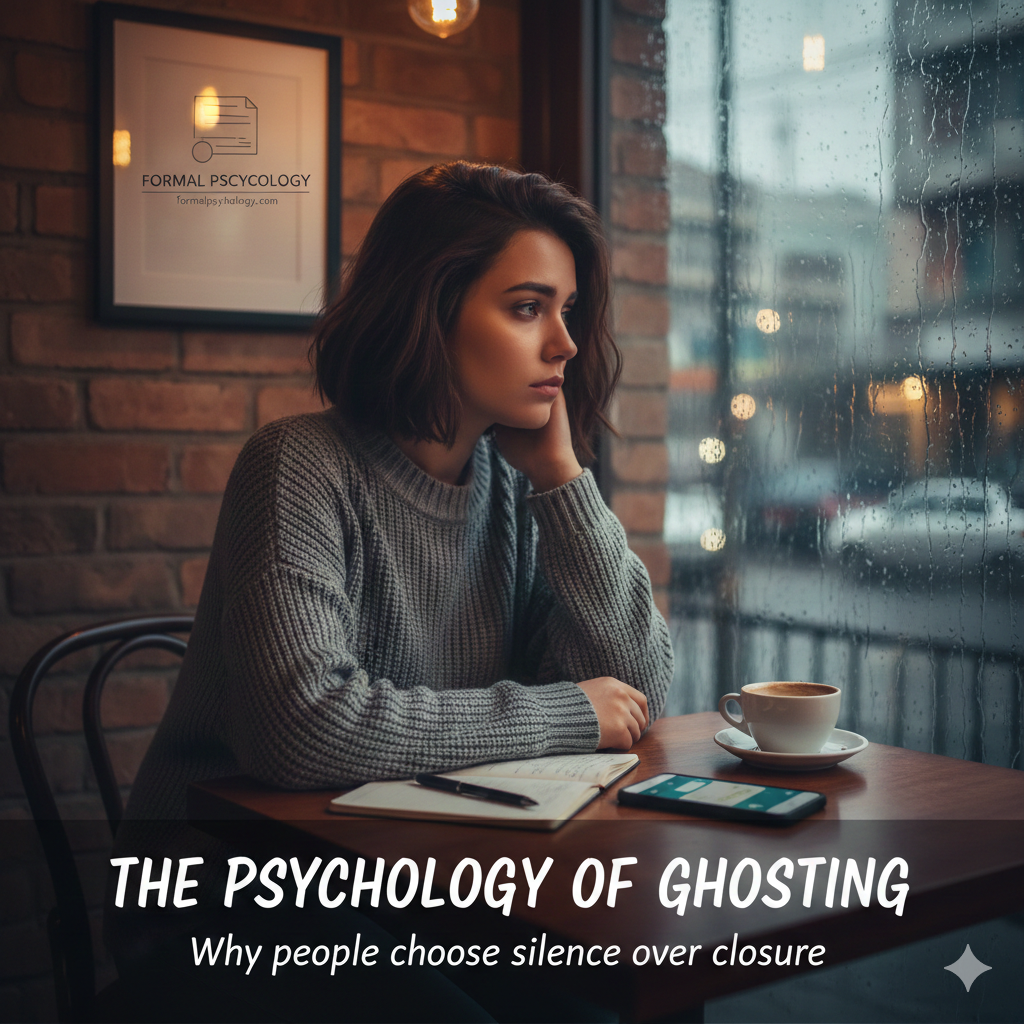

In the modern landscape of digital communication, the “seen” receipt has become a psychological weapon. Ghosting—the act of suddenly withdrawing from all communication without explanation—has evolved from a dating trend into a widespread social phenomenon.
Understanding the Ghosting Phenomenon
Ghosting isn’t just about “disappearing.” It is a strategic (though often subconscious) avoidance behavior. While it is most prevalent in romantic contexts, it has permeated friendships and professional environments.
The Role of “Growth” vs. “Destiny” Beliefs
Psychological research suggests that a person’s mindset regarding relationships significantly influences their likelihood to ghost:
- Destiny Beliefs: Individuals who believe in “soulmates” are more likely to ghost if they feel the person isn’t “the one.” They view the relationship as flawed from the start, making communication feel unnecessary.
- Growth Beliefs: Those who view relationships as something to be nurtured through effort are statistically less likely to ghost, as they value the process of communication.
The “Why” Behind the Silence: Psychological Drivers
Why do people choose a vanishing act over a five-minute conversation? The answer lies in a mix of self-preservation and cognitive efficiency.
| Driver | Psychological Explanation |
| Avoidance of Conflict | Many ghosters suffer from high communication apprehension. They view confrontation as a physical threat and use silence to bypass the “emotional fallout” of a breakup. |
| Cognitive Overload | In the era of “infinite choice” (dating apps), individuals experience decision fatigue. It is mentally easier to discard a connection than to provide an individualized explanation for every exit. |
| Dehumanization | Digital interfaces can lead to dissociation. When a person is reduced to a profile picture and a text bubble, the “ghoster” may fail to acknowledge the human empathy required for closure. |
| The Power Dynamic | Silence is a form of control. By withholding information, the ghoster maintains the upper hand in the narrative of the relationship. |
The Impact on the Ghosted: “Ostracism via Algorithm”
The psychological toll on the recipient is often more severe than a traditional rejection.
- Social Pain as Physical Pain: Functional MRI (fMRI) studies show that social rejection activates the same neural pathways as physical pain. Ghosting, specifically, is a form of social ostracism.+1
- The “Ziegarnik Effect”: This psychological principle states that people remember uncompleted or interrupted tasks better than completed ones. Because there is no closure, the brain stays in a “loop,” constantly searching for clues to explain the disappearance.
- Attributional Ambiguity: Without a reason, the victim often internalizes the rejection, leading to a “shame spiral” where they blame their own perceived flaws for the other person’s silence.
Is Ghosting Ever Justified?
While generally considered a breach of social etiquette, psychologists recognize certain scenarios where ghosting serves as a safety mechanism:
- Protection from Toxicity: If a partner is abusive, manipulative, or ignores boundaries, “going dark” is often the safest method of exit.
- Mental Health Preservation: When the effort of explaining a departure compromises one’s own psychological stability.
Moving Toward “Warm Choice”
At Formal Psychology, we advocate for the “Warm Choice”—a brief, transparent message that provides an ending without the need for a long-winded debate.
Expert Tip: Closure is something you give yourself; it is not something you receive from others. Waiting for a ghoster to explain themselves gives them continued power over your emotional state.




Leave a Comment