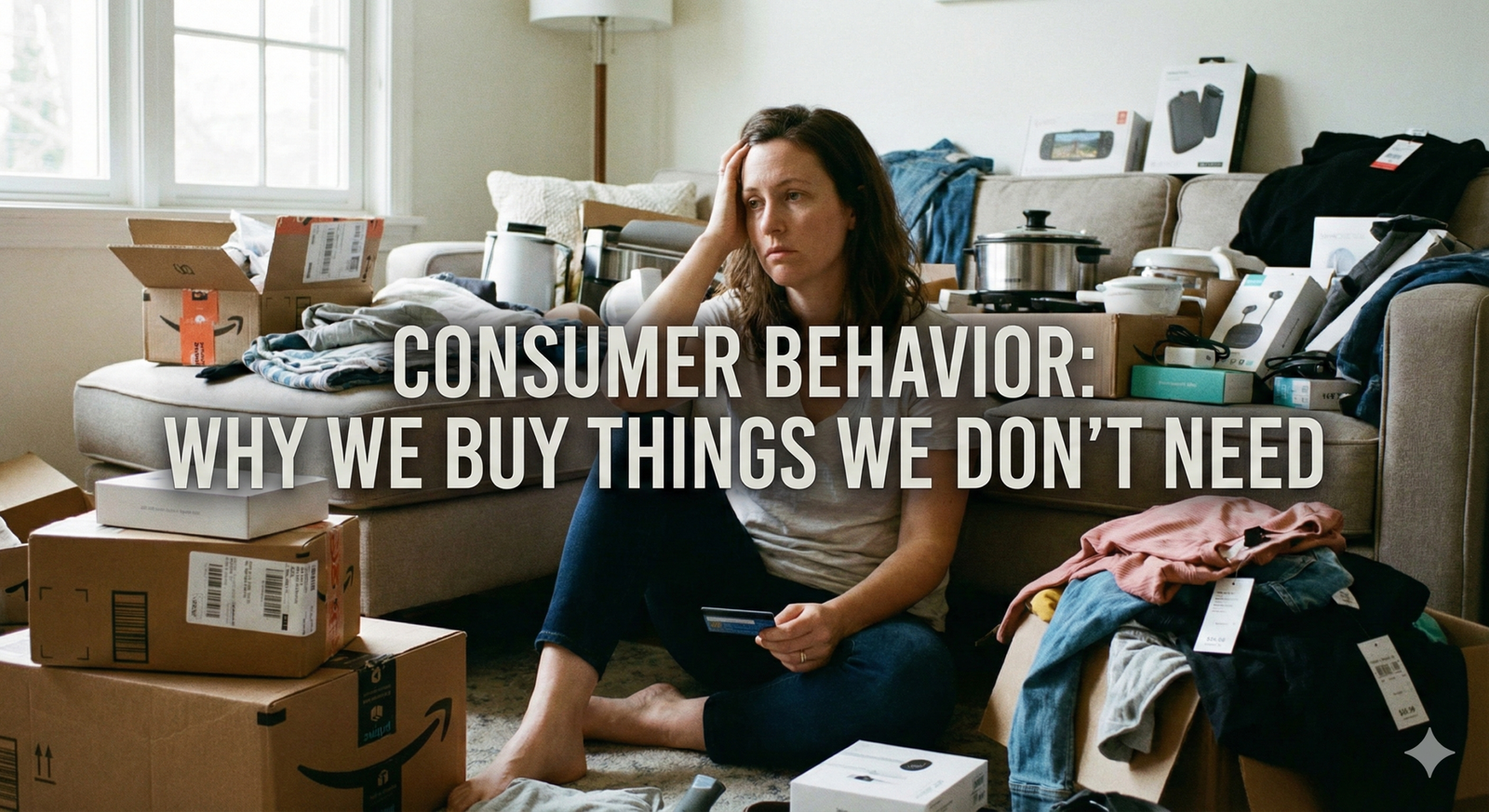

We have all been there. You walk into a store for a single necessity—perhaps a carton of milk or a pair of socks—and you walk out with a shopping cart full of items you never intended to buy. Later, as the initial rush of acquisition fades, you are left staring at the pile, wondering, “Why did I buy this?”
At Formal Psychology, we believe that understanding the “why” is the first step to regaining control. Buying things we don’t need isn’t just a lack of willpower; it is a complex interplay of evolutionary biology, emotional regulation, and sophisticated marketing tactics designed to bypass your rational brain.
Here is a deep dive into the psychology of consumer behavior and the hidden forces that drive our spending habits.
1. The Diderot Effect: The Spiral of Consumption
One of the most powerful drivers of unnecessary spending is a phenomenon known as the Diderot Effect. Named after the French philosopher Denis Diderot, this concept explains how obtaining a new possession often creates a spiral of consumption which leads you to acquire more new things.
Diderot experienced this when he was gifted a beautiful scarlet robe. Suddenly, his old possessions seemed drab by comparison. He replaced his old rug, then his chair, then his desk, until his entire environment matched the elegance of the robe.
Psychological Insight: We view our possessions as a reflection of our identity. When a new item (like a new smartphone) deviates from our current “identity standard,” we feel a psychological tension. To resolve this dissonance, we buy accessories (cases, headphones, chargers) to make everything match, creating a chain reaction of purchases.
2. Dopamine and the “Reward” Loop
Our brains are wired to seek rewards. When we see something we want, our brain releases dopamine, a neurotransmitter associated with pleasure and anticipation. Interestingly, dopamine spikes before the purchase, during the anticipation phase, not necessarily after we own the item.
- The Hunt: Shopping triggers the ancient “hunter-gatherer” instinct. Finding a deal feels like a successful hunt.
- The Instant Gratification: In a world of high stress, purchasing offers a quick hit of relief and excitement.
This creates a compulsion loop. We feel stressed or bored $\rightarrow$ We browse/shop $\rightarrow$ We get a dopamine hit $\rightarrow$ We feel temporary relief $\rightarrow$ The feeling fades, and we repeat the cycle.
3. Retail Therapy: Emotional Regulation
“Retail therapy” is a colloquial term for a very real psychological mechanism: Compensatory Consumption.
When we feel a lack of control in one area of our lives (e.g., a bad day at work, relationship issues), we try to restore a sense of order and autonomy by making purchasing decisions. Buying something is a clear, immediate action that says, “I have the power to change my environment.”
Furthermore, spending can be an attempt to bridge the gap between our “actual self” (who we are now) and our “ideal self” (who we want to be). We don’t just buy running shoes; we buy the idea of being a fit, healthy athlete.
4. The Scarcity Principle and FOMO
Marketers are masters of leveraging the Scarcity Principle. This cognitive bias posits that humans place a higher value on an object that is scarce and a lower value on one that is abundant.
- Limited Time Offers: “Sale ends in 2 hours!” creates artificial urgency, shutting down the analytical part of the brain (the prefrontal cortex) and activating the emotional centers.
- Exclusive Editions: “Only 50 items left in stock” triggers the Fear Of Missing Out (FOMO). We buy not because we need the item, but because we are terrified of losing the opportunity to have it.
5. Anchoring and The Relativity of Value
How do we know if a product is expensive or cheap? We rarely judge value in absolute terms; we judge it relatively. This is known as Anchoring.
Stores often place a very expensive item (the anchor) next to a moderately expensive item. For example, a $2,000 watch makes the $500 watch next to it seem like a “steal,” even if you don’t need a watch at all. You aren’t paying $500; you feel like you are saving $1,500.
6. Social Proof and Status Signaling
As social animals, we look to others to determine correct behavior. This is Social Proof. If a product has thousands of 5-star reviews or is being used by influencers we admire, we assume it is valuable.
Beyond utility, consumption is often about Status Signaling. Thorstein Veblen coined the term “conspicuous consumption” to describe buying luxury goods to publicly display economic power. In modern psychology, this extends to “fitting in.” If your peer group upgrades their tech, you feel a social pressure to conform to remain part of the “in-group.”
7. Decision Fatigue
Why are candy bars and magazines placed at the checkout counter? Because by the time you reach the register, you are suffering from Decision Fatigue.
The human brain has a finite amount of willpower each day. After making dozens of decisions while shopping (Which brand? Which size? Is it organic?), your brain is exhausted. When you finally reach the checkout, your self-control is depleted, making you highly susceptible to impulse buys—usually sugary snacks or small, cheap gadgets you don’t need.
Conclusion: Breaking the Cycle
Understanding consumer behavior is not about stopping all spending; it is about moving from impulsive consumption to intentional consumption.
Psychological strategies to regain control:
- The 24-Hour Rule: Force a delay between the impulse and the purchase. This allows the dopamine spike to settle and the rational brain to come back online.
- Identify the Trigger: Ask yourself, “Am I buying this because I need it, or because I am bored, sad, or insecure?”
- Calculate in Hours: Convert the price of the item into hours of work. Is that gadget worth 10 hours of your labor?
By recognizing these psychological traps, we can navigate the modern marketplace with greater awareness, ensuring that our purchases align with our true needs and values, rather than our temporary impulses.