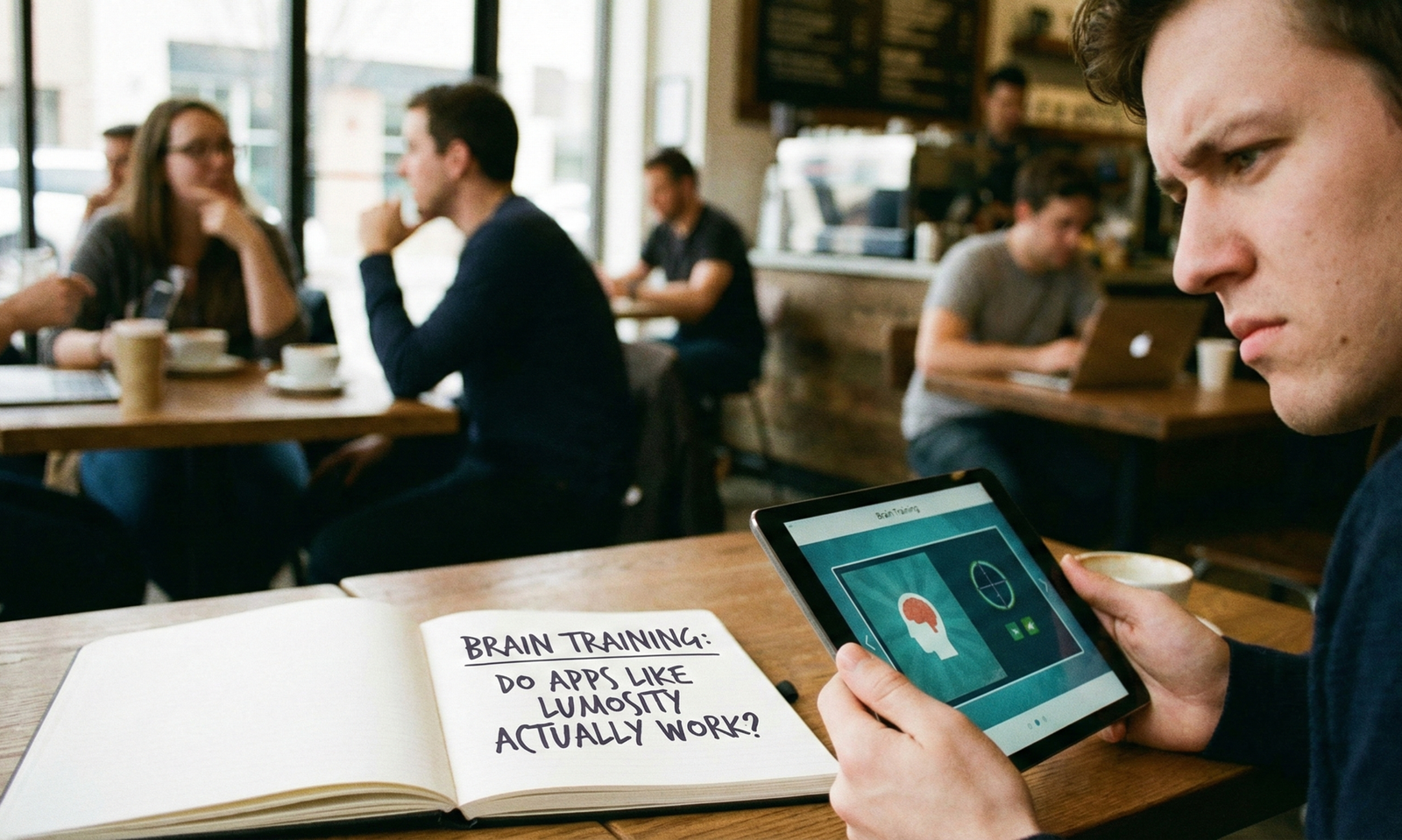

Brain training apps have revolutionized the self-improvement industry, promising that just 15 minutes of daily “gaming” can sharpen your memory, boost your IQ, and even stave off mental decline. This multi-billion dollar market, spearheaded by giants like Lumosity, Peak, and Elevate, is built on the seductive idea that we can upgrade our brains just as easily as we upgrade software.
But as psychologists, we must ask: does the science match the marketing? At Formal Psychology, we dug into the research to separate the neuro-hype from the neuro-reality.
The Promise: Harnessing Neuroplasticity
The scientific foundation of brain training apps is neuroplasticity—the brain’s remarkable ability to reorganize itself by forming new neural connections throughout life.
Historically, scientists believed the brain stopped developing after childhood. We now know that the adult brain remains “plastic.” It can change structurally and functionally in response to learning and experience. These apps claim to gamify this process, using specific puzzles to target “cognitive domains” like:
- Working memory
- Processing speed
- Attention
- Problem-solving
The Evidence: The Problem of “Transfer”
To understand if these apps work, you must understand the psychological concept of transfer. This is the gold standard for any cognitive intervention.
1. Near Transfer (The Easy Part)
Near transfer occurs when training on a specific task improves your performance on very similar tasks.
- Example: If you play a game where you must memorize a sequence of flashing blue lights, you will undoubtedly get better at memorizing flashing blue lights.
- Verdict: Yes, brain training apps excel at this. If you play Lumosity every day, your scores within the app will improve.
2. Far Transfer (The Holy Grail)
Far transfer occurs when training on a specific task improves your performance on unrelated tasks or general cognitive abilities in daily life.
- Example: Does memorizing those flashing blue lights help you remember where you left your keys, help you focus better in a chaotic meeting, or improve your general intelligence ($g$)?
- Verdict: The evidence is weak to non-existent.
Major studies and meta-analyses in cognitive psychology have consistently found that while participants improve at the games themselves, these improvements rarely “transfer” to real-world cognitive utility. In 2016, a team of psychologists at the University of Illinois reviewed over 370 citations regarding brain training and concluded there was little evidence that the games improved real-world performance.
The Lumosity FTC Settlement
The distinction between fun games and medical tools became a legal issue in 2016. The Federal Trade Commission (FTC) reached a $2 million settlement with Lumos Labs (the creators of Lumosity).
The FTC charged that the company deceived consumers with unfounded claims that its games could help users perform better at work and in school, and even delay serious conditions like dementia and Alzheimer’s disease. Since then, these companies have had to be much more careful with their language, often pivoting to vague terms like “wellness” rather than specific medical outcomes.
The Placebo Effect
Why do so many users swear by these apps? The answer may lie in the placebo effect.
In a study conducted at George Mason University, researchers recruited two groups of people.
- Group A was told they were participating in a “Brain Training and Cognitive Enhancement” study.
- Group B was told they were participating in a standard study for credit (with no mention of brain training).
Both groups played the same games. Group A, expecting to get smarter, showed a temporary boost in IQ scores. Group B did not. The expectation of improvement often creates the feeling of improvement.
Who Might Actually Benefit?
While they are not a magic pill for the general population, these tools aren’t useless.
- Rehabilitation: There is some evidence that specific cognitive training can help individuals recovering from stroke or Traumatic Brain Injury (TBI) regain lost functions.
- The “Use It or Lose It” Crowd: For sedentary elderly individuals who engage in very little mental stimulation, these apps are certainly better than staring at a wall. They provide a baseline of cognitive engagement.
Real Alternatives for Cognitive Health
If you want to genuinely improve your brain health and induce neuroplasticity, “Formal Psychology” recommends evidence-based lifestyle changes over subscription apps:
| Activity | Why It Works |
| Physical Exercise | Aerobic exercise (running, swimming) increases blood flow to the hippocampus, the brain area critical for memory and learning. This is the single most effective brain booster. |
| Learn a New Skill | Learning a new language or a musical instrument forces the brain to build vast new networks. This is “far transfer” in action. |
| Social Engagement | Socializing requires complex, real-time processing of verbal and non-verbal cues, keeping the brain agile. |
| Sleep | Sleep is when your brain clears out metabolic waste (via the glymphatic system) and consolidates memories. |
Conclusion
Do brain training apps work? If your goal is to get very good at playing brain training games, then yes. They are fun, engaging, and can be a part of a healthy routine.
However, if your goal is to raise your IQ, prevent Alzheimer’s, or remember your anniversary, these apps are likely not the answer. The human brain is best trained not by tapping a screen, but by engaging with the complex, physical, and social world it evolved to navigate.