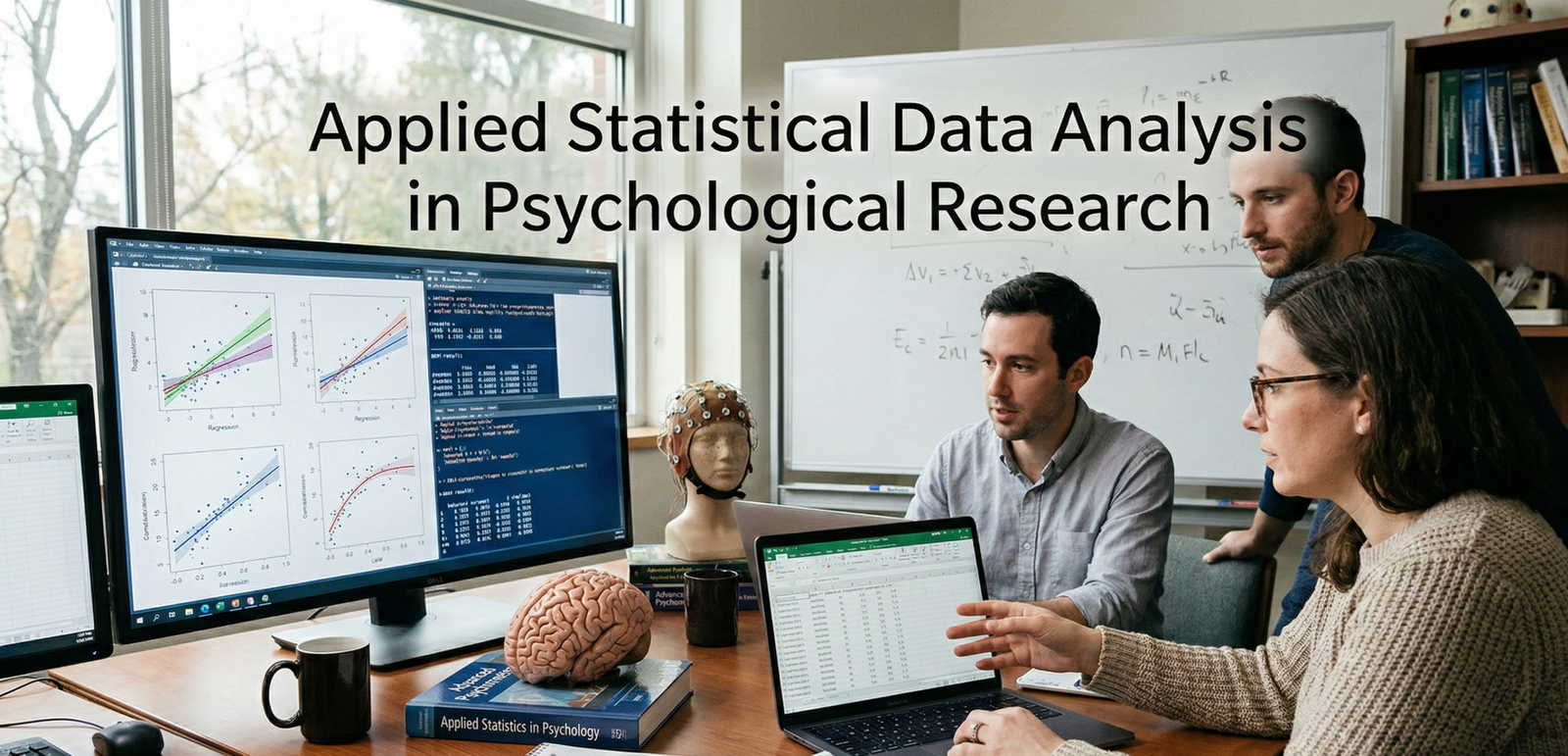

At the heart of modern behavioral science lies Applied Statistical Data Analysis in Psychological Research. Psychology is far more than the study of thoughts and behaviors through observation alone; it is a rigorous empirical science. Without robust statistical frameworks, psychological theories remain untested hypotheses.
In modern, high-level psychological curricula, mastering quantitative methods, probability theories, and advanced statistical modeling is no longer optional—it is the bedrock of credible research. This comprehensive guide to Applied Statistical Data Analysis in Psychological Research delves into the essential statistical components that drive modern psychological discoveries forward.
The Foundation: Probability Theories in Psychology
Before diving into complex models, researchers must understand the foundation of all statistical inference: probability theory. Psychology deals with human behavior, which is inherently variable. Probability allows researchers to quantify this uncertainty and make informed generalizations about a population based on a sample.
Key Probability Concepts
- The Normal Distribution: Most psychological traits, such as intelligence (IQ) or extraversion, follow a bell-shaped curve. Understanding the normal distribution allows researchers to identify what is statistically “typical” versus “atypical.”
- Hypothesis Testing and P-Values: At the core of psychological research is null hypothesis significance testing (NHST). Researchers calculate the probability ($p$-value) of observing their data if the null hypothesis were true. While the traditional $p < 0.05$ threshold is a staple, modern psychology emphasizes effect sizes and confidence intervals to provide a more nuanced understanding of probability.
- Bayesian Probability: Increasingly taught in advanced curricula, Bayesian statistics update the probability of a hypothesis as more evidence becomes available, offering a dynamic alternative to traditional frequentist approaches.
Core Quantitative Methods
To make sense of raw data, psychologists rely on a toolkit of core quantitative methods. These techniques allow researchers to compare groups, identify relationships, and predict outcomes.
Analysis of Variance (ANOVA)
When researchers need to compare the means of three or more groups (e.g., testing the efficacy of three different therapeutic interventions on anxiety levels), ANOVA is the method of choice. It partitions the observed variance into components attributable to different sources of variation.
Regression Analysis
Regression goes beyond simple correlation by allowing researchers to predict the value of a dependent variable based on one or more independent variables. This is a staple of Applied Statistical Data Analysis in Psychological Research.
- Simple Linear Regression: Models the relationship between two variables using the foundational equation:$$Y = \beta_0 + \beta_1X + \epsilon$$
- Multiple Regression: Evaluates the impact of multiple predictors simultaneously, helping researchers control for confounding variables. For example, predicting academic performance based on sleep quality, study hours, and stress levels.
Advanced Statistical Modeling
As psychological questions become more complex, so do the statistical tools required to answer them. High-level psychological curricula now heavily feature advanced modeling techniques to analyze intricate data structures.
Structural Equation Modeling (SEM)
SEM is a powerful multivariate technique used to evaluate complex theoretical models. It combines factor analysis and multiple regression, allowing researchers to test structural relationships between measured variables and latent constructs (unobservable variables like “depression” or “cognitive load”).
Hierarchical Linear Modeling (HLM)
Also known as multilevel modeling, HLM is essential when data is nested or clustered. For example, if studying student performance, students are nested within classrooms, which are nested within schools. HLM accounts for the shared variance among individuals within the same group, preventing skewed results that treat all data points as completely independent.
Factor Analysis
Exploratory Factor Analysis (EFA) and Confirmatory Factor Analysis (CFA) are critical in psychometrics—the design and validation of psychological tests. They help researchers reduce large datasets into fewer underlying dimensions, ensuring that a questionnaire designed to measure “introversion” is accurately targeting that specific construct.
The Role of Statistics in Modern Psychological Curricula
Why is there such a heavy emphasis on these quantitative tools in modern psychology programs?
- Navigating the Replication Crisis: In recent years, psychology has faced a “replication crisis” where classic studies failed to be reproduced. Rigorous statistical training—including pre-registration of studies, adequate statistical power, and transparent data analysis—is the discipline’s primary defense against faulty science.
- The Rise of Big Data: Psychologists now have access to massive datasets from smartphones, wearables, and social media. Analyzing these datasets requires advanced quantitative methods and even introductory machine learning techniques.
- Evidence-Based Practice: Clinical and applied psychologists rely on peer-reviewed research to inform their practice. A deep understanding of statistical data analysis ensures that practitioners can critically evaluate the literature and apply the most effective, empirically supported treatments.
Conclusion
Applied Statistical Data Analysis in Psychological Research is the vital engine that powers the entire field. By mastering probability theories, core quantitative methods, and advanced statistical modeling, psychologists can elevate their research from observational theory to rigorous, reproducible science. For students and researchers navigating high-level curricula, embracing these quantitative tools is the key to unlocking the complex, data-driven truths of human behavior.