
In the digital age, the mirror on the wall has been replaced by the screen in our hand. For decades, psychology has studied the relationship between traditional media (magazines, television) and body dissatisfaction. However, the rise of social media has introduced a more pervasive and psychologically complex variable: the “Filtered Life.”
Unlike passive consumption of celebrity images, social media invites active participation in a curated reality. This article explores the psychological mechanisms driving the crisis of body image in the digital era, examining how filters, algorithms, and social feedback loops are reshaping our self-perception.
1. The Psychology of Comparison: Why We Compete
To understand the impact of social media on body image, we must first look at Social Comparison Theory, originally proposed by psychologist Leon Festinger in 1954. Festinger posited that individuals have an innate drive to evaluate their own opinions and abilities by comparing themselves to others.
On social media, this manifests in two distinct forms:
- Upward Social Comparison: Comparing oneself to someone perceived as “better” (e.g., more attractive, thinner, wealthier). This often leads to feelings of inadequacy, envy, and lower self-esteem.
- Downward Social Comparison: Comparing oneself to someone perceived as “worse off.” While this can temporarily boost self-esteem, it reinforces a judgmental hierarchy based on appearance.
The “Highlight Reel” Effect
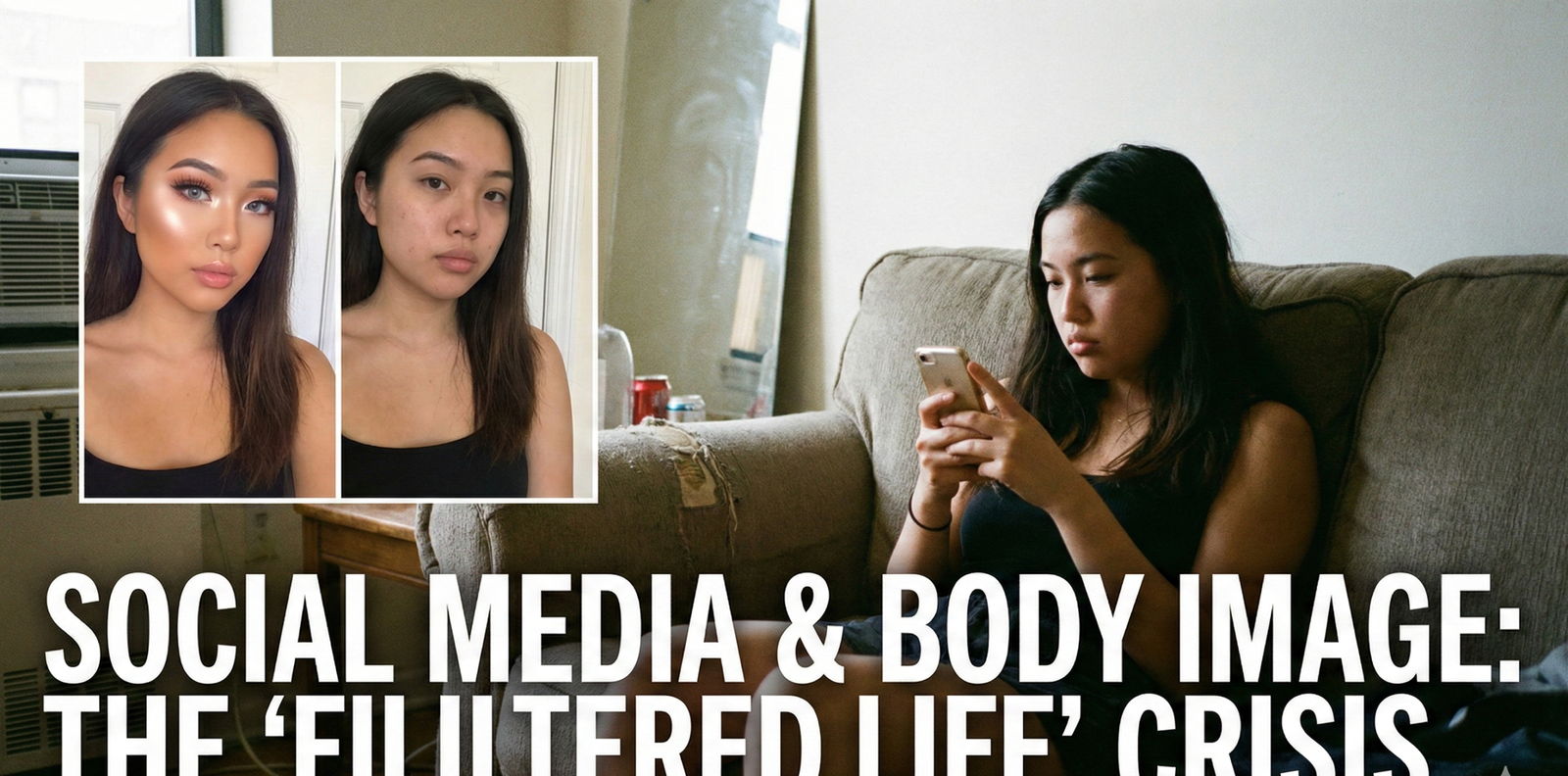
The crisis stems from the fact that users are often engaging in upward comparison against a dataset that is statistically impossible to achieve. A user’s “behind-the-scenes” (their messy, unfiltered reality) is being compared to another person’s “highlight reel” (a carefully staged, lit, and edited moment). The brain, evolutionarily wired for social ranking, often fails to distinguish between these artificial constructs and reality.
2. The “Filtered Life” and “Snapchat Dysmorphia”
The term “Snapchat Dysmorphia” has emerged in medical and psychological communities to describe a specific form of Body Dysmorphic Disorder (BDD). Unlike traditional BDD, where a patient might want to look like a celebrity, patients with Snapchat Dysmorphia seek cosmetic procedures to look like filtered versions of themselves.
Psychological Implications of Filters:
- Normalization of Unreality: Filters that smooth skin, enlarge eyes, and thin noses create a homogenized standard of beauty (often called “Instagram Face”) that is anatomically rare or impossible without surgical intervention.
- The Disconnect Gap: When a user takes a photo with a beautifying filter, they experience a dopamine hit. However, seeing their actual reflection in a mirror afterwards can trigger a “reality crash,” leading to distress and a rejection of their natural self.
- Third-Person Effect: Constant selfie-taking forces users to view themselves from a third-person perspective (as an object to be viewed) rather than a first-person perspective (as a subject living a life). This leads to self-objectification, a known precursor to eating disorders and depression.
3. The Validation Loop: Likes as Currency
Behavioral psychology explains social media addiction through operant conditioning. “Likes,” comments, and shares act as variable reward schedules. When a user posts a photo that adheres to societal beauty standards and receives high engagement, the behavior is reinforced.
- Quantified Self-Worth: Self-esteem becomes contingent on external metrics. A lack of engagement is often internalized as social rejection or physical inadequacy.
- Algorithmic Bias: Social media algorithms prioritize high-engagement content. Visually striking, often sexually objectified or heavily edited bodies tend to receive more engagement. Consequently, the algorithm feeds users more of this content, creating an echo chamber that reinforces narrow beauty ideals.
4. Vulnerable Populations and Mental Health Outcomes
While the “Filtered Life” affects all demographics, certain groups are at higher psychological risk.
Adolescents and Identity Formation
Adolescence is a critical period for identity formation (Erikson’s stage of Identity vs. Role Confusion). When this developmental phase occurs online, the “imaginary audience”—the adolescent belief that everyone is watching them—becomes a literal, digital audience. This heightens appearance anxiety and the pressure to conform.
Correlated Disorders
Research indicates strong correlations between heavy visual social media use and:
- Body Dysmorphic Disorder (BDD): An obsession with perceived flaws in appearance.
- Orthorexia Nervosa: An unhealthy obsession with healthy eating, often fueled by “wellness” influencers.
- Depression and Anxiety: Specifically related to social exclusion and appearance evaluation.
5. Moving Forward: Psychological Interventions
Addressing the “Filtered Life” crisis requires a multi-faceted approach involving individual regulation and systemic change.
- Media Literacy: Cognitive Behavioral Therapy (CBT) techniques can help users challenge “automatic thoughts” triggered by scrolling (e.g., changing “She is perfect, and I am not” to “She is using good lighting and editing; this is a constructed image”).
- Curating the Feed: Users are encouraged to practice “digital hygiene” by unfollowing accounts that trigger inadequacy and following accounts that promote body neutrality or diversity.
- Platform Responsibility: There is a growing push for platforms to label altered images. However, psychological research suggests that even labeled images can negatively impact body image, as the visual imprint remains stronger than the disclaimer.
Conclusion
The “Filtered Life” is not merely a technological trend; it is a psychological crisis affecting how we define human value. By understanding the mechanisms of social comparison and the addictive nature of digital validation, we can begin to untangle our self-worth from our pixels. True psychological resilience in the digital age involves recognizing that while our screens may be filtered, our inherent worth is not.