
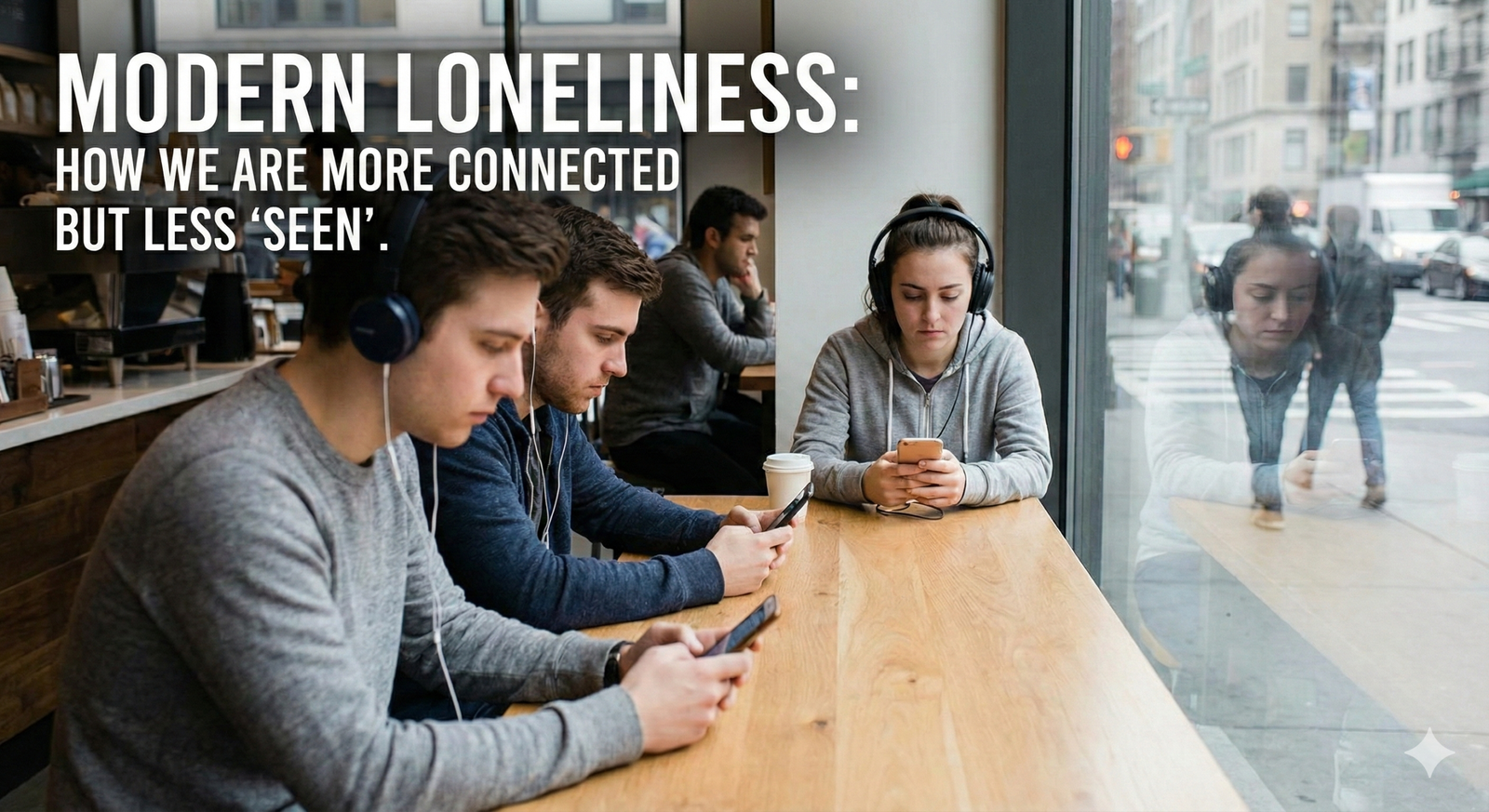
In the 21st century, we are technically never alone. Our pockets vibrate with notifications, our feeds are updated by the second, and we can video call someone on the other side of the planet instantly. Yet, psychologists and researchers are observing a rising pandemic that defies this technological connectivity: Modern Loneliness.
This is not the isolation of a castaway; it is a specific, pervasive ache felt in crowded rooms and active group chats. It is the distinct psychological difference between being connected and being seen.
The Paradox of High Connectivity and Low Intimacy
Modern loneliness is defined by a lack of emotional resonance rather than a lack of social contact. In psychology, we distinguish between social network size (the number of contacts you have) and social support quality (the depth of reliance and intimacy).
Digital platforms are engineered to maximize network size but often degrade support quality. We have traded conversation for connection, and vulnerability for visibility.
The “Viewer” vs. The “Witness”
On social media, we have an audience, not witnesses.
- Being Viewed: This is passive. People see your curated highlights, your vacation photos, or your career updates. They consume your content as data.
- Being Seen: This is active and psychological. To be “seen” means someone understands your internal state, validates your emotions without judgment, and witnesses your vulnerability.
The modern mental health crisis stems from the fact that we are viewed by thousands, but seen by few.
The Psychological Mechanics of Digital Isolation
Why does scrolling through a feed often leave us feeling emptier? Several psychological mechanisms are at play.
1. Social Comparison Theory
Festinger’s Social Comparison Theory suggests we evaluate our own worth by comparing ourselves to others. In the past, we compared ourselves to neighbors. Today, we compare our “behind-the-scenes” reality with everyone else’s “highlight reel.” This constant upward comparison triggers feelings of inadequacy and exclusion, fueling loneliness even when we are interacting online.+1
2. The Dopamine Loop vs. Oxytocin
Likes, comments, and shares trigger dopamine—the neurotransmitter of anticipation and reward. It feels good momentarily, like a sugar rush. However, deep human bonding releases oxytocin—the “cuddle hormone” responsible for trust and safety. Digital interactions rarely trigger oxytocin release. We are chemically overfed (dopamine) but malnourished (oxytocin).+1
3. The Loss of Non-Verbal Cues
Albert Mehrabian’s communication model suggests that a vast majority of emotional communication is non-verbal (tone, micro-expressions, body language). Text-based communication strips away these cues. Without them, our brains struggle to co-regulate with others, leaving us feeling “unfelt” even after a long text conversation.
The Symptoms of Modern Loneliness
How do you know if you are suffering from this specific type of isolation?
- Hyper-connectivity fatigue: Feeling exhausted by notifications but anxious when you disconnect.
- Performative happiness: Feeling like you must maintain a “brand” of happiness online, which creates a gap between your digital self and your authentic self.
- The “Empty Inbox” feeling: Having unread messages but feeling like you have no one to call in a crisis.
Moving from Connection to Connection Quality
At Formal Psychology, we believe the antidote to modern loneliness isn’t necessarily deleting social media, but changing how we engage with it. Here is how to reclaim the feeling of being seen.
1. Practice “Friction” in Communication
Efficiency is the enemy of intimacy. Sending a “reaction” emoji is frictionless but empty.
- The Fix: Instead of liking a post, send a voice note. Hearing a voice reintroduces tone and nuance, bridging the psychological distance.
2. Vulnerability is the Price of Admission
You cannot be seen if you remain hidden. Brene Brown’s research on vulnerability highlights that connection is impossible without the risk of exposure.
- The Fix: Share a struggle, not just a success. When you lower your shield, you give others permission to do the same, deepening the bond.
3. The “20-Minute” Rule
Sherry Turkle, a researcher on technology and self, argues for the sanctity of conversation.
- The Fix: Commit to 20 minutes of uninterrupted, phone-free conversation with a partner or friend. Eye contact and undivided attention are the primary signals the brain needs to feel “safe” and “seen.”
Conclusion
We are living in an era of mass intimacy without depth. While technology has solved the problem of distance, it has created the problem of distraction. To combat modern loneliness, we must prioritize messy, inefficient, face-to-face interactions over sleek, digital connectivity.
We must stop settling for being watched, and start doing the brave work of letting ourselves be seen.